How to Stop Living Paycheck to Paycheck: The 2026 “Ghost Paycheck” Strategy
Quick Verdict: The “Ghost Paycheck”
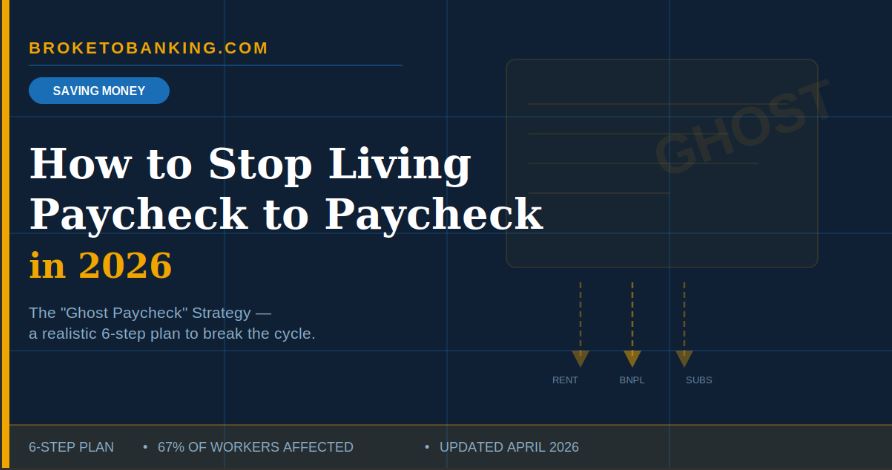
Let’s stop pretending that “cutting out lattes” is the cure for a $2,500 rent payment. In 2026, most people living paycheck to paycheck aren’t “bad with money” — they are victims of the Ghost Paycheck. Before your salary even hits your account, 80% of it is already claimed by past decisions: auto-drafted rent, BNPL installments from three months ago, and subscriptions you forgot you owned. You aren’t “spending” your money. You’re just a temporary stop for it on its way to your creditors.
If you want to break the cycle, you don’t need willpower. You need to break the Reactive Cycle. Here is the skeptical, 6-step plan to take back your vote on where your money goes.
The “Stack” (Do This First): Build your $400 Anxiety Anchor before anything else. One unexpected expense without it sends you straight into the debt spiral. The “Runner Up”: The Payday Sequencing Re-Map — flip the order your money moves on payday and everything changes. The “Skip”: Any app that gives you a paycheck advance (Dave, Earnin). These are the Mickey Mouse version of a payday loan. They don’t fix the cycle — they just move the pain to next Tuesday.
The Honest Context
According to PNC Bank’s 2025 Financial Wellness Report, 67% of American workers say they’re living paycheck to paycheck — up from 63% the year before. And it’s not a low-income problem. Among households earning over $100,000 per year, nearly half say they have little or nothing left after monthly expenses.
Between 2020 and 2025, rent rose more than 20% in most U.S. cities and food prices climbed 25% overall according to Bureau of Labor Statistics data. Wages simply haven’t kept pace. You are not bad with money. The system is genuinely expensive. What you can control is the structure of how money moves through your account — and that’s exactly what this plan addresses.
Step 1: The “Stomach-Turning” 90-Day Audit
The Verdict: STACK ✅
Why it works:
Most people would rather have a root canal than look at their last 90 days of transactions. Do it anyway.
The BNPL Ghost: Look for the micro-leaks. Buy Now Pay Later (Klarna, Affirm, Afterpay) is the biggest trap of 2026. These aren’t “bills” in the traditional sense — they are invisible ghosts that haunt your account at random times of the month, regardless of when you get paid. List every active BNPL commitment. Most people are shocked by the total.
The Loyalty Tax: Total up what you pay for car insurance and internet. If you’ve been with the same provider for more than two years, you are almost certainly paying a $300–$500 annual “loyalty tax” because you haven’t threatened to cancel yet. That number goes down the moment you use the word “cancel” on the phone.
The categories to audit:
- Housing (rent/mortgage)
- Transportation (payment, insurance, gas)
- Food (groceries vs. dining out — separate these)
- All subscriptions — streaming, apps, software, gym
- Debt minimums
- BNPL installments (every active one)
The Skeptic’s Friction Report:
The Depressing Total Problem: This audit will make you feel worse before it makes you feel better. That’s normal. You need accurate data before you can make accurate decisions. Push through it.
The Annual Subscription Trap: Some of your most expensive subscriptions only appear once a year. Check your email for renewal receipts going back 12 months — Amazon Prime, cloud storage, annual software. These hide from monthly audits and quietly drain $300–$500 per year from most households.
Step 2: Build the “Anxiety Anchor” ($400 First)
The Verdict: STACK ✅
Why it works:
Standard advice says “save 6 months of expenses.” That is an impossible mountain when you’re currently at zero. Ignore it for now.
The first goal: save exactly $400. Here’s why that number specifically. The Federal Reserve found that 37% of Americans cannot cover a $400 unexpected expense without borrowing or selling something. This is the exact threshold where most households tip into the debt spiral.
The Math: If your car tire blows and you don’t have $400, it goes on a credit card at 22.8% APR. That $400 repair starts generating roughly $7.50 in interest every single month you carry it — and minimum payments barely touch the principal. The $400 buffer is your insurance policy against the spiral ever starting.
Where to keep it: In a High-Yield Savings Account like Ally or Marcus — currently around 4.2% APY, no minimums, no fees. It needs to be in a different app than your checking account so you don’t “accidentally” spend it on groceries. The friction of a separate account is the point.
The Skeptic’s Friction Report:
The “But I Have Debt” Problem: Saving $400 while carrying credit card debt at 22.8% feels mathematically wrong. It isn’t. Every time an emergency forces you to add to your credit card balance, you lose. The buffer prevents the next emergency from making things worse while you’re paying down the debt that already exists.
Step 3: The “Payday Sequencing” Re-Map
The Verdict: STACK ✅
Why it works:
The Ghost Paycheck survives because of the order in which you pay things. Most people pay whatever is due first, spend on what they want, and save what’s left. There is never anything left. Parkinson’s Law: spending expands to fill available income. Every time.
The New Sequence: On payday, money moves in this exact order before you spend a single discretionary dollar:
- The Anchor — $25–$50 straight to your separate HYSA
- The Essentials — Rent, utilities, groceries allocation
- The Minimums — All debt minimums
- The Rest — This is your actual guilt-free spending money
If “The Rest” is zero or negative, you don’t have a spending problem — you have an income or fixed-cost problem. Move to Step 4.
The Skeptic’s Friction Report:
The Timing Problem: Auto-drafts don’t care about your payday sequence. Some bills pull mid-cycle regardless of when you get paid. The fix: call each biller and request a payment date change to within 3 days of payday. Most companies will do this with one phone call.
Step 4: Attack the “Big Two” (Rent and Wheels)
The Verdict: STACK ✅
Why it works:
You cannot budget your way out of a housing payment that is 50% of your income. The real money is in the Big Two — not subscription audits.
The Rent Freeze: If your lease is up, don’t just sign the increase. Landlords in 2026 face higher vacancy rates in many cities. Call them. Remind them you’ve paid on time. Even a $50/month reduction is $600 per year back in your pocket — and it costs you one phone call.
The Insurance Audit: Call your car insurance company and tell them you’re shopping around. If they don’t drop your rate, actually shop around. You’ve been subsidizing new customer discounts for years. The Loyalty Tax is real and the only way to beat it is to leave or credibly threaten to.
The Skeptic’s Friction Report:
The Competitive Market Problem: In hot rental markets, some landlords won’t negotiate. If that’s your reality, the transportation and subscription wins are your primary levers. Don’t spend energy on a negotiation you’ve already lost.
Step 5: The “Clutter Graveyard” (Fast Cash)
The Verdict: STACK ✅
Why it works:
If your buffer is at zero, the fastest path to $400 isn’t a side hustle. It’s selling the junk in your closet.
Most households have hundreds of dollars in unused items sitting in drawers and closets. That old gaming console, the “I’ll wear them eventually” shoes, the kitchen appliance you used twice — this is your Anxiety Anchor sitting in a box. List three things on Facebook Marketplace today. Move every dollar you make directly to your separate HYSA before you have a chance to redirect it.
For ongoing income beyond the initial sell-off: check Benefits.gov for programs you qualify for. A 10-minute eligibility screening covers over 1,000 federal and state programs — SNAP, energy assistance, Medicaid, childcare subsidies. Millions of Americans who qualify never apply.
The Skeptic’s Friction Report:
The Payday App Trap: Apps like Dave and Earnin are not solutions. One company’s most common advance carries an effective APR of 750% according to a New York Attorney General lawsuit. These apps extend the paycheck-to-paycheck cycle by one week — they don’t break it. SKIP.
Step 6: The “22.8% House Fire”
The Verdict: STACK ✅
Why it works:
Once your $400 buffer is set, every extra dollar goes to credit card debt. No exceptions.
The Math: At 22.8% APR — the 2026 national average — your credit card balance is a financial house fire. Investing in the stock market (historically averaging around 10% annually) while carrying 22.8% debt is a guaranteed 12.8% net loss on every dollar you invest instead of paying down debt. Put the fire out first.
Snowball vs. Avalanche:
- Avalanche (highest interest first): Saves the most money mathematically
- Snowball (smallest balance first): Wins psychologically for many people
Research suggests people who use the Snowball method are more likely to actually complete their debt payoff — the early wins matter. As skeptics, we say: do whatever keeps you from quitting. Pick one and execute it.
The Skeptic’s Friction Report:
The “I Should Invest Instead” Problem: If your employer matches 401(k) contributions, contribute enough to get the full match before paying extra on debt. That match is a 50–100% guaranteed return that beats even 22.8% APR mathematically. Beyond that — pay the cards first.
The Honest Timeline
Month 1: The Audit. You’ll feel annoyed and slightly sick. This is normal — it’s called the Learning Phase.
Month 3: The $400 buffer is built. You’ll stop panicking when the “Check Engine” light comes on. This is the moment the Reactive Cycle breaks.
Month 12: The Ghost Paycheck is gone. You’re paying for today’s life with today’s money.
The Priority Order: Do Not Deviate
| Step | Action | Why |
|---|---|---|
| This week | Complete the 90-day audit | You can’t fix what you can’t see |
| Week 2 | Open a separate HYSA | Ally or Marcus, 4.2% APY, no minimums |
| Week 3 | Start building the $400 Anchor | Breaks the Reactive Cycle |
| Month 1 | Remap your Payday Sequence | Flip the order, change the outcome |
| Month 2 | Attack the Big Two | Rent and insurance wins |
| Month 3+ | Every extra dollar to high-interest debt | 22.8% guaranteed return |
FAQ
How to stop living paycheck to paycheck if I’m already in debt? Build your $400 buffer first — even while carrying debt. Without it, every emergency adds more debt and resets your progress. Once the buffer exists, attack high-interest debt with everything you have.
Can you stop living paycheck to paycheck on a low income? Yes, but it requires both sides — cutting the biggest fixed costs and adding any additional income. Even $100–$150 per month in additional income changes the timeline significantly.
How long does it actually take? Most people feel meaningfully less stressed within 90 days of consistent effort. Fully breaking the cycle — buffer built, high-interest debt cleared, positive monthly cash flow — typically takes 12–24 months depending on income and existing debt load.
What’s the fastest way to build the $400 buffer when you have nothing? Sell something this week. List three items on Facebook Marketplace today and move every dollar you make to a separate savings account before you spend it.
Should I use Dave or Earnin to cover expenses? No. These are payday loans with a better interface. One company’s most common advance carries an effective APR of 750% per a New York AG lawsuit. They do not break the cycle — they extend it by one week.
BrokeToBanking is an independent personal finance blog. We may earn commissions from products we recommend. Our editorial opinions are never influenced by affiliate relationships.
Related Articles: