How to Build an Emergency Fund From Zero: The “Financial Armor” Strategy (2026)
Quick Verdict: The “One Flat Tire Away” Problem
In 2026, the term “middle class” is being redefined by one metric: liquidity. Most families are one flat tire, one sudden expense, or one hospital copay away from a debt spiral. If you don’t have a cash buffer, you aren’t “living life” — you are just managing a series of high-interest crises.
An emergency fund isn’t “savings.” It’s Financial Armor. It is the only thing that stops a $400 problem from becoming a $1,000 credit card balance at 22.8% APR.
The numbers back this up. According to Bankrate’s 2026 Emergency Savings Report, only 47% of Americans have enough savings to cover a $1,000 emergency. A separate U.S. News survey found that 43% couldn’t cover that same expense at all. And 1 in 3 Americans has zero emergency savings — none.
Here is the skeptical, no-fluff guide to building that armor when your budget is already stretched thin.
The “Stack” (Do This First): $500. Not six months of expenses. Not $1,000. Just $500 in a separate account you don’t touch. That’s your Psychological Anchor. The “Runner Up”: Automate the transfer before you see the money. Willpower is a finite resource. Automation is infinite. The “Skip”: Waiting until you “have more money” to start. You’ll never have it. Start with $10.
Why Most People Never Build One (And Why That’s Not Their Fault)
Before the tactics, the honest diagnosis.
According to Empower research, 58% of Americans say saving for emergencies feels “almost impossible” with how expensive everything is right now. 39% say rising prices are the biggest roadblock. And 52% regret not starting sooner.
That last number — 52% — is worth sitting with. More than half of Americans don’t have an emergency fund not because they’re irresponsible, but because housing, groceries, and everything else have genuinely eaten the margin that used to exist between income and expenses.
The traditional advice — “just save three to six months of expenses” — is delivered as though the gap between zero and $15,000 is just a matter of discipline. It isn’t. The tactics below work with that reality, not against it.
Step 1: The “Psychological Anchor” — $500, Not 6 Months
The Verdict: STACK ✅
Standard financial advice tells you to save “three to six months of expenses.” For a household of five, that’s likely $15,000 to $25,000. If you’re starting at zero, that number is so big it’s demotivating. It feels like trying to climb Everest in flip-flops.
The 2026 target: Aim for $500 first.
Why $500 specifically? Because the majority of budget-killers — a broken laptop for school, a sick kid’s prescription, a minor car repair — fall under this amount. These are the expenses that currently go straight on a credit card.
The math: A $500 buffer isn’t about wealth. It’s about avoiding a $500 charge on a credit card. At 22.8% APR — the 2026 national average — that “emergency” would cost you over $110 in interest alone over 12 months. The $500 is your shield against the credit card companies.
The progression:
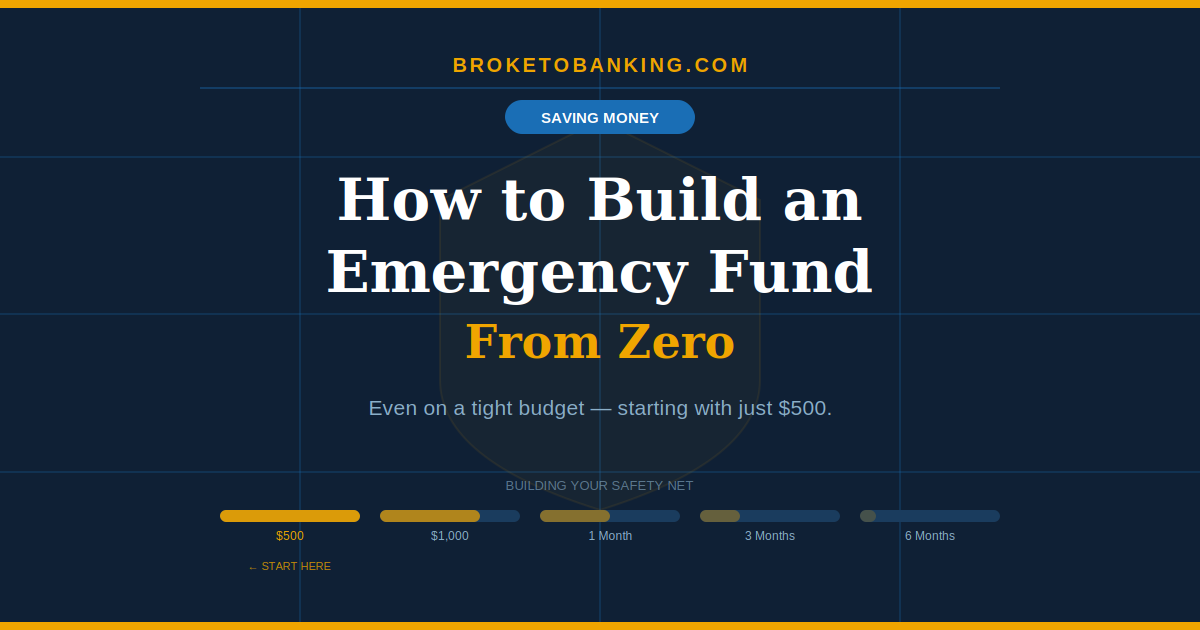
- Phase 1: $500 — stops the flat tire debt spiral
- Phase 2: $1,000 — covers 90% of household crises
- Phase 3: 1 month of essential expenses — security during a short work gap
- Phase 4: 3–6 months — total financial independence
Nobody builds a six-month emergency fund in month one. People build it $25 at a time over 18 months, and then one day they realize they have it.
The Skeptic’s Friction Report:
The “Should I Pay Debt First?” Problem: Build $500 first, then aggressively attack high-interest debt. Without the $500, every emergency adds more debt and resets your progress. With it, you can pay down debt without derailing at the first obstacle.
Step 2: The “Friction” Account — Open a HYSA Today
The Verdict: STACK ✅
If you keep your emergency fund in your primary checking account, it will disappear. It doesn’t matter how disciplined you are — visible money gets spent. Every time.
The strategy: Open a High-Yield Savings Account at a bank like Ally or Marcus. Takes 10–15 minutes. No minimums, no monthly fees.
The yield gap: Big banks are still paying a shameful 0.01%–0.40%. Online HYSAs are hovering around 4% APY in 2026. On a fully funded $10,000 account, that’s $400 per year in free money versus $40 at a traditional bank. Same money. Zero extra effort.
The “Good” Friction: It takes 1–3 days to move money from a HYSA back to your checking account. This is a feature, not a bug. It prevents impulse spending while keeping the money accessible enough for actual crises. Keep $100–$200 in checking as an instant buffer for anything that genuinely cannot wait.
Around 37% of Americans store their emergency fund in a regular savings account and 23% keep it in their checking account. Nearly 1 in 5 keep cash at home. All three of these are mistakes — they either earn nothing, get absorbed into daily spending, or aren’t FDIC insured. The separate HYSA solves all three problems.
The Skeptic’s Friction Report:
The Transfer Speed Problem: A HYSA is not for money you need in the next 60 minutes. It’s for money you need this week. If you have a genuine same-day emergency, put it on a card and pay it off the moment the HYSA transfer clears. That’s the correct workflow.
Step 3: Finding the “Hidden” Seed Money
The Verdict: STACK ✅
When you’re already living paycheck to paycheck, you don’t “find” money — you have to extract it. Here’s where it actually comes from.
The Ghost Audit: Check your last 90 days of bank statements for Zombie Subscriptions — recurring charges you forgot about. If you haven’t used a service in two weeks, kill it. Even $20 per month is $240 per year toward your Psychological Anchor. Most people find $40–$80 per month in forgotten subscriptions during this audit.
The Inventory Liquidation: Most households have $300–$400 of unused items sitting in closets — old electronics, clothes that no longer fit, kids’ gear they’ve outgrown. List three things on Facebook Marketplace this weekend. That is your immediate seed money. Move every dollar you make directly to the HYSA before it touches your checking account.
The Windfall Rule: In 2026, treat any extra money — tax refunds, birthday cash, a work bonus — as if it doesn’t exist. Route it directly to the HYSA before it touches your checking account. The average tax refund in 2025 was over $3,000. That’s six months of $500 contributions in one deposit.
The Benefits Check: Benefits.gov has an eligibility screener covering over 1,000 federal and state programs — SNAP, energy assistance, Medicaid, childcare subsidies. Millions of Americans who qualify never apply. Reducing a bill you’re currently paying in full with a subsidy you didn’t know about is the same as finding money.
The Skeptic’s Friction Report:
The Irregular Income Problem: If your income varies month to month — freelance, gig work, commission — don’t set a fixed contribution. Set a percentage instead. 5% of every payment goes to the HYSA automatically the day it arrives. This scales with income and doesn’t create a shortfall in lean months.
Step 4: Automation — The “Set and Forget” Habit
The Verdict: STACK ✅
Willpower is a finite resource. Automation is infinite.
The setup: Schedule a recurring transfer for payday. Even if it’s only $15. Log into your HYSA, find the recurring transfer option, and set it for the day after your paycheck hits. Do it right now before you finish reading this.
The psychology: If you wait until the end of the month to “see what’s left,” the answer will always be zero. Parkinson’s Law — spending expands to fill available income — guarantees it. By moving the money the second your paycheck lands, you force your lifestyle to adjust to the remaining balance. The account adapts. You don’t have to.
The Escalator: Every time you get a raise or a win — in your side business, at work, anywhere — increase the automatic transfer by 10%. You won’t feel the difference because you were already living without that money. But your buffer will.
The Skeptic’s Friction Report:
The “But I Need Everything I Make” Problem: If your income genuinely doesn’t cover essential expenses, automation won’t solve a math problem. In that case, the priority is either reducing your biggest fixed costs (rent, insurance, subscriptions) or finding additional income. Even $100–$200 per month changes the math significantly. The emergency fund gets built from the new margin, not from money that doesn’t exist.
Step 5: Defining the “Emergency” — The Replacement Rule
The Verdict: STACK ✅
If you spend your emergency fund on a “once-in-a-lifetime” vacation, you are back at zero. An emergency fund that gets used for non-emergencies is just a savings account with extra steps.
The definition: An emergency is Unplanned, Necessary, and Urgent.
True emergencies:
- Job loss or significant income reduction
- Medical or dental expense not covered by insurance
- Car repair needed to get to work
- Essential home repair (heat, water, structural)
- Family emergency requiring travel
Not emergencies:
- A sale that won’t come back
- A vacation you really need
- A new phone because yours is old (not broken)
- Holiday gifts
- Anything you had more than two weeks to plan for
The test: If you had known this was coming 30 days ago, could you have planned for it in your regular budget? If yes, it’s not an emergency.
The Replacement Protocol: If you dip into the fund for a legitimate reason, your budget immediately enters Emergency Mode. No dining out, no extras, nothing discretionary until the fund is refilled. The emergency fund replenishment goes to the front of the line — ahead of everything except rent and utilities.
The Skeptic’s Friction Report:
The “I Deserved It” Trap: The most common way emergency funds disappear isn’t car repairs — it’s justified discretionary spending. A trip you really needed. Clothes for a job interview. A gift you couldn’t say no to. None of these are emergencies. Find another way to cover them or wait. The fund is armor — wearing it for non-battles leaves you exposed when the real fight comes.
The Realistic Progression Table
| Phase | Goal | Target | Why |
|---|---|---|---|
| Phase 1 | The Anchor | $500 | Stops the flat tire debt spiral |
| Phase 2 | The Buffer | $1,000 | Covers 90% of household crises |
| Phase 3 | The Month | 1 Month | Security during a short work gap |
| Phase 4 | The Shield | 3–6 Months | Total financial independence |
Start Phase 1 this week. Every other financial goal — debt payoff, investing, saving for something specific — runs alongside this, not instead of it.
The Skeptic’s Final Advice
Building an emergency fund from zero is an act of defiance. It’s you telling the bank that you aren’t going to pay them 22% interest just because life happened.
Don’t wait until you have “extra” money. You’ll never have it. Start with $10. Start with selling a box of old clothes. Start with the $500 Psychological Anchor. Once that money is sitting in a separate account, the world starts to look a lot less threatening.
The math is not complicated. The discipline is not superhuman. The only requirement is starting before the next flat tire.
FAQ
How much should my emergency fund be? Start with $500. That’s the Psychological Anchor — it covers the most common budget-killers and breaks the reactive debt cycle. Build from there toward $1,000, then one month, then three to six months of essential expenses.
Should I build an emergency fund or pay off debt first? Build $500 first, then attack high-interest debt. Without the buffer, you pay down debt during good months and add more during bad ones — and never actually make progress.
Where is the best place to keep an emergency fund? A high-yield savings account at an online bank — Ally or Marcus are both solid choices. No minimums, no fees, FDIC insured, and earning around 4% APY. Keep it separate from your checking account so you’re not tempted to spend it.
What if I can only save $10 or $20 per month? Start anyway. $20 per month becomes $240 in a year. It’s not the full goal but it’s the habit, the account, and the momentum — all of which matter more than the balance in year one.
Can I invest my emergency fund to earn more? No. Your emergency fund is not an investment — it’s insurance. It needs to be immediately accessible without risk of loss. The stock market can drop 30% in a month. Your emergency fund cannot. Keep it in a HYSA and invest separately once the fund is fully built.
BrokeToBanking is an independent personal finance blog. We may earn commissions from products we recommend. Our editorial opinions are never influenced by affiliate relationships.
Related Articles: