Best Side Hustles to Make Extra Money in 2026 (That Actually Pay)
Quick Verdict: The Hustle Honesty Test
The internet is full of side hustle advice, but most of it falls into two camps: the “make $10,000 a month passively!” fantasy (you won’t) or the “take surveys for $3 an hour!” grind (you shouldn’t). What’s missing is the honest middle ground — realistic ways to make an extra $300–$1,000 a month that fit around a real job, don’t require startup money you don’t have, and actually respect your time.
In 2026, with high interest rates and persistent inflation, an extra $500 a month isn’t just “fun money” — it’s your shield against what we’ve been calling the daily cost of modern financial life. But the old side hustle lists are recycled fluff from 2019. With Generative AI changing the freelance landscape and the $600 1099-K reporting threshold giving the IRS unprecedented visibility into gig income, the rules have shifted.
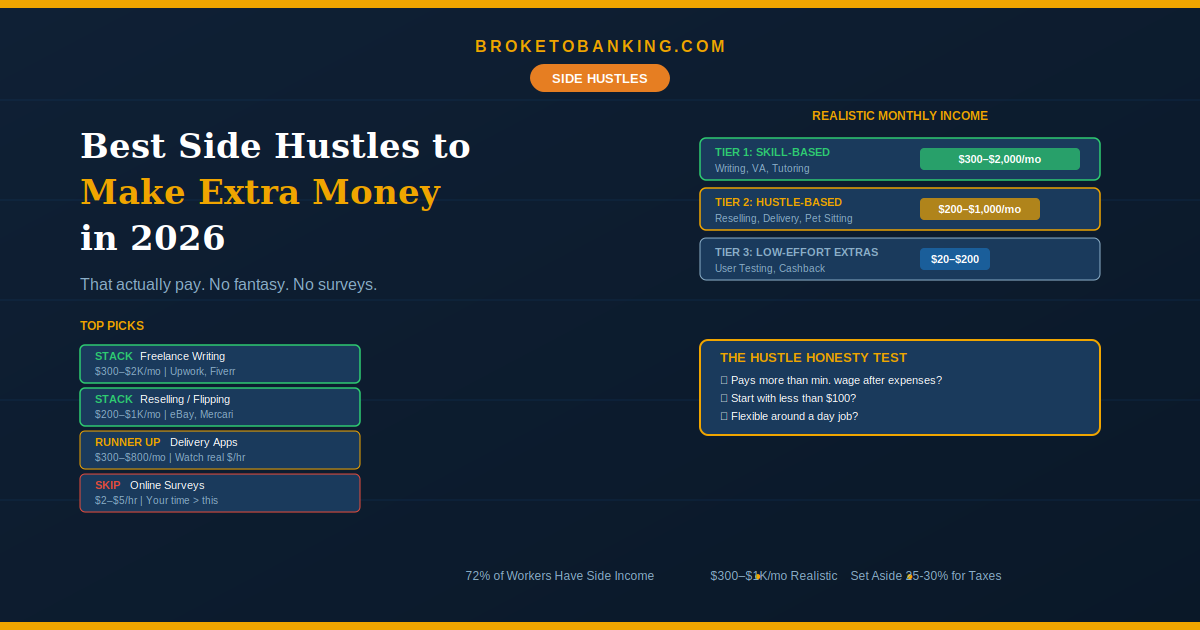
We applied the Hustle Honesty Test to every option: Does it pay more than minimum wage after expenses? Can you start with less than $100? Can you do it on a flexible schedule alongside a day job? If the answer to any of those is “no,” it didn’t make the list.
The Quick Verdict:
- STACK: Freelance services (writing, design, VA work) ✅ — Highest earning potential per hour. These skills make you a more valuable person, not just a busier one.
- STACK: Reselling / flipping ✅ — Best for people who enjoy the hunt. Low startup cost, flexible hours, scalable.
- RUNNER UP: Delivery and gig apps — Fast to start, but calculate your real hourly rate after gas, maintenance, and wear. Best used as a Bridge, not a long-term strategy.
- RUNNER UP: Tutoring — Excellent if you have subject expertise. $25–$75/hour is realistic.
- SKIP: Online surveys and “passive income” apps ❌ — Most pay $2–$5/hour. That’s a Time Tax — your only non-renewable resource traded for pennies.
Tier 1: Skill-Based Hustles (The $25+/Hour Club)
These require a marketable skill — but “marketable skill” is broader than you think. If you can write clearly, organize information, manage a social media account, or connect two apps with Zapier, you qualify.
Freelance Writing — The “AI-Proof” Play
Realistic range: $300–$2,000/month (part-time)
Despite the AI boom, businesses in 2026 are desperate for human-vetted content. The opportunity isn’t just “writing” — it’s editing AI-generated drafts, technical writing, and high-empathy sales copy that a bot can’t replicate. Businesses don’t pay for words; they pay for Information Gain — writing that adds genuine new value a reader can’t get from a ChatGPT prompt. Platforms like Upwork, Fiverr, and ProBlogger connect you with clients. New writers typically charge $0.05–$0.15 per word.
The Skeptic’s Friction Report: The first two months are brutal. Lots of applications, lots of rejections. Most people quit before month three. The strategy: pick a boring niche (insurance, SaaS, logistics) where the pay is high and the competition is low. Content demand is actually increasing in 2026 specifically because businesses want human-quality writing that AI alone can’t reliably produce.
Virtual Assistant — The “Systems Architect”
Realistic range: $500–$2,000/month (part-time, 10–15 hrs/week)
Small business owners and solopreneurs are drowning in tools. They need help with email management, scheduling, data entry, customer service, and basic social media. If you’re organized and reliable, that’s the skill. If you also know how to bridge two apps using Zapier or Make, you’re not just an assistant — you’re a Systems Architect, and you can charge $25–$45/hour instead of $15.
The Skeptic’s Friction Report: VA work is real work with real deadlines. It’s flexible but not passive. The upside: recurring clients mean predictable monthly income, which makes budgeting significantly easier.
Tutoring
Realistic range: $400–$1,500/month (part-time)
If you’re strong in math, science, a foreign language, or test prep, platforms like Wyzant and Tutor.com connect you with students. In-person rates range from $25–$75/hour depending on subject and location. Online tutoring is slightly lower but fully remote.
The Skeptic’s Friction Report: SAT/ACT prep and college-level math command premium rates. Basic homework help pays less. Building a roster of recurring students creates reliable income.
Tier 2: Hustle-Based Income (Flexible, Lower Skill Barrier)
These don’t require specialized skills, but they require hustle, consistency, and physical effort.
Reselling / Flipping — The Arbitrage Play
Realistic range: $200–$1,000/month
You’re moving items from where they’re undervalued (thrift stores, garage sales, Facebook Marketplace) to where they’re highly valued (eBay, Poshmark, Mercari). Common profitable categories: vintage clothing, electronics, books, collectibles, and household goods.
This connects directly to a concept we introduced in Post #12: Dead Capital — unused items sitting in your house that are worth real money to someone else. Start by selling what you already own (the Liquidation Sprint), then reinvest profits into sourced inventory.
The Skeptic’s Friction Report: Don’t be a generalist. Pick one category and become an expert on pricing. The learning curve is steep — you’ll buy things that don’t sell, you’ll underprice things worth more. And if you don’t have the discipline to list items within 48 hours of buying them, you’re just a hoarder with a hobby. Expect 2–3 months before you develop an eye for profitable inventory.
Delivery / Gig Apps — The Bridge Strategy
Realistic range: $300–$800/month (10–15 hrs/week)
The fastest way to turn hours into dollars with zero startup. Download the app, pass a background check, start delivering. Gross earnings look good — $15–$25/hour during busy periods.
The Skeptic’s Friction Report: This is where the Gross vs. Net Trap catches people. After gas, vehicle maintenance, depreciation, and self-employment taxes, your real hourly rate drops significantly. One experienced driver calculated his true rate at roughly $11/hour after expenses. Use delivery apps as a Bridge — if you need $200 for a car repair tomorrow, they’re a win. As a long-term strategy, they’re a slow leak in your net worth. Don’t forget to set aside 25–30% for taxes — this is 1099 income (see our irregular income guide for the Tax Trap Shield).
Dog Walking / Pet Sitting
Realistic range: $200–$600/month
Rover and Wag connect you with pet owners who need walks, drop-in visits, or overnight sitting. Rates vary by location, but $15–$25 per walk and $30–$75 per night of sitting are typical. Income becomes predictable once you build recurring clients.
The Skeptic’s Friction Report: Background check required. Success depends heavily on location. The income ceiling is limited by hours, but it’s genuinely flexible and low-stress.
Tier 3: Low-Effort Extras (Won’t Change Your Life, But Won’t Waste Your Time)
User Testing
Realistic range: $50–$200/month
Platforms like UserTesting pay $10–$60 per test to review websites and apps. Tests take 15–30 minutes. Availability is inconsistent. Great supplemental income, not standalone.
Cashback and Rewards Optimization
Realistic range: $20–$100/month in recovered value
Browser extensions like Rakuten and Honey apply cashback and coupon codes automatically. We talked about Zombie Subscriptions eating your budget — this is the opposite: tools that actually pay you back.
The Side Hustle Decision Matrix
| Your Situation | Best Fit | Why |
|---|---|---|
| You have a skill (writing, design, coding) | Freelancing | Highest $/hour, scalable, compounds over time |
| You’re organized and reliable | Virtual assistant | Recurring income, flexible hours |
| You’re good at a school subject | Tutoring | $25–$75/hr, remote options |
| You enjoy treasure hunting | Reselling/flipping | Low startup, can be fun |
| You need money this week | Delivery apps (Bridge only) | Fastest start, watch the real $/hr |
| You love animals | Dog walking/pet sitting | Low stress, recurring clients |
| You just want small wins | User testing + cashback | Minimal effort, minimal but real |
The Tax Reality (Don’t Skip This)
Every dollar of side hustle income is taxable. If you earn more than $400 from self-employment in a year, you owe self-employment tax (15.3%) on top of your regular income tax. With the 1099-K threshold at $600, the IRS has more visibility into platform income than ever.
The move: set aside 30% of every payment into a separate high-yield savings account immediately — your money earns interest while it waits for the IRS. We detailed this system in our irregular income budgeting guide as the Tax Trap Shield. Don’t learn this lesson the hard way in April.
FAQ
What’s the best side hustle if I have no skills?
You have skills — you’re probably just undervaluing them. If you can write a clear email, you can freelance write. If you can keep a calendar organized, you can be a VA. If you were good at math in school, you can tutor. Start there before defaulting to delivery apps.
How much can I realistically make from a side hustle?
Most side hustlers working 10–15 hours per week earn $300–$1,000 per month. Skill-based hustles trend toward the higher end. Gig-based hustles trend lower. The variable is how much your time is worth per hour.
Won’t a side hustle burn me out?
It can if you pick the wrong one. The best side hustle fits your energy, not fights it. If you’re exhausted after work, don’t sign up for delivery driving. If you’re an introvert, don’t pick tutoring. Match the hustle to your actual life.
What about “passive income”?
Skip it — for now. In 2026, “passive income” for beginners is usually a scam to sell you a course. Real passive income requires either significant capital to invest (which our target reader doesn’t have yet) or a product/audience you’ve already built. Focus on active income first, build your financial foundation, and passive income becomes realistic later.
The bottom line: Audit your real hourly rate. If you aren’t making more than $20/hour after expenses, you aren’t hustling — you’re being exploited. Pick a skill-based hustle, treat it like a business from day one, and let it compound into something that makes you more valuable, not just busier.
This article is for educational and informational purposes only. BrokeToBanking.com does not provide financial advice. Please consult a qualified financial professional for guidance specific to your situation.
BrokeToBanking is an independent personal finance blog. We may earn commissions from products we recommend. Our editorial opinions are never influenced by affiliate relationships.
Related Articles: