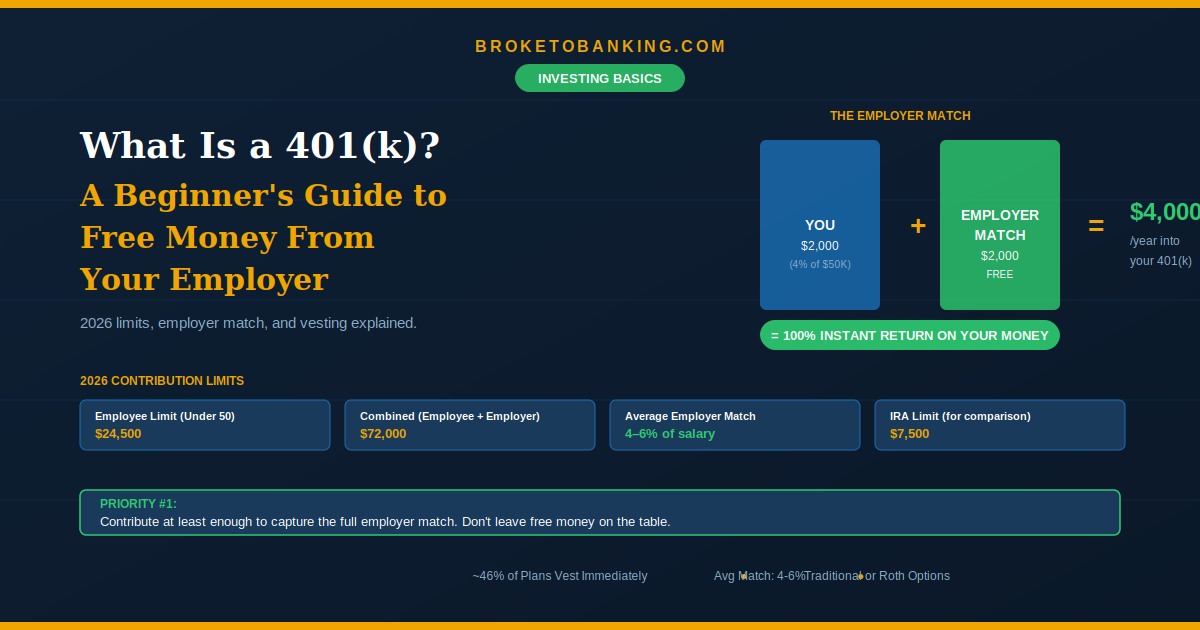
What Is a 401(k)? A Beginner’s Guide to Free Money From Your Employer (2026)
Quick Verdict: The Match Is a Salary You’re Not Collecting
A 401(k) is a retirement savings account offered through your job. You contribute a percentage of your paycheck, and in many cases, your employer contributes additional money on top — for free. That employer match is the single best return on investment available to most workers. No stock pick, no side hustle, no savings account comes close to a guaranteed 50–100% return on your money.
But here’s the way to really think about it: a 401(k) match is a Salary Negotiation Tool. If your employer offers a match and you aren’t contributing enough to get it, you are essentially accepting a lower salary than your coworker who does contribute. Same job, same title, less total compensation — because you’re leaving money on the table.
This guide explains how 401(k) plans work, what the 2026 contribution limits are, what “vesting” means (and why it matters more than most people realize), and how a 401(k) fits alongside the Roth IRA we covered in our Roth IRA guide.
The Quick Verdict:
- STACK: Contribute at least enough to get the full employer match ✅ — This is the #1 move in personal finance. Period.
- STACK: Know your vesting schedule ✅ — The match isn’t really “yours” until you’re vested. Leaving too early can forfeit thousands.
- RUNNER UP: Use the Roth 401(k) option — If you’re early in your career, paying taxes now to avoid taxes on decades of growth is the ultimate Compound Interest Cheat Code.
- SKIP: Ignoring your 401(k) because retirement “feels far away” ❌ — Every year you wait costs you decades of compound growth.
How a 401(k) Actually Works
1. You contribute a percentage of your paycheck. The money comes out before it hits your bank account — either pre-tax (Traditional 401(k)) or after-tax (Roth 401(k)). You choose the percentage. Most plans let you change it anytime.
2. Your employer may match part of your contribution. This is the “free money” part. The average employer match in 2026 is roughly 4–6% of salary. According to Fidelity, the most common match formula is $1-for-$1 on the first 3% of salary, plus $0.50 on the dollar for the next 2%. So if you contribute 5% of your pay, your employer effectively adds another 4%.
3. The money gets invested. Your 401(k) isn’t a savings account — it’s an investment account. You choose from a menu of funds (typically index funds, target-date funds, and bond funds). The money grows tax-deferred.
4. You pay taxes when you withdraw in retirement. With a Traditional 401(k), you get a tax break now and pay income tax on withdrawals in retirement. With a Roth 401(k), you pay taxes now but withdrawals are completely tax-free — the same tax-free growth we explained in our Roth IRA guide.
The 2026 Numbers You Need to Know
| Limit | 2026 Amount | What It Means |
|---|---|---|
| Employee contribution (under 50) | $24,500 | Up from $23,500 in 2025 |
| Catch-up (ages 50–59, 64+) | +$8,000 (total $32,500) | Standard catch-up |
| Super catch-up (ages 60–63) | +$11,250 (total $35,750) | New SECURE 2.0 rule |
| Combined employee + employer | $72,000 | The hard cap on all contributions |
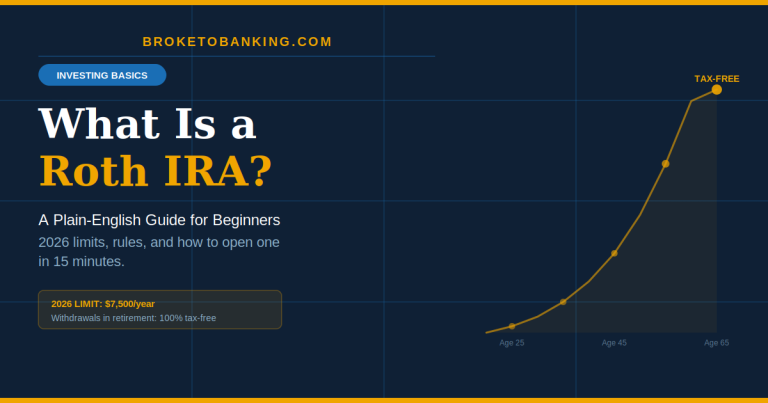
| IRA limit (for comparison) | $7,500 | Separate from your 401(k) |
For most beginners, the $24,500 limit is far more than you’ll contribute right away — and that’s fine. The priority isn’t maxing out. The priority is capturing the full employer match.
2026 high-earner rule: If you earned more than $150,000 in the prior year, the IRS now requires all catch-up contributions to be made on a Roth (after-tax) basis. The base $24,500 deferral can still be traditional or Roth.
The Employer Match: Your Best Financial Move
Let’s make the math concrete.
Example: You earn $50,000/year. Your employer matches 100% up to 4% of salary.
- You contribute 4% = $2,000/year from your paycheck
- Your employer matches 100% = $2,000/year in free money
- Total going into your 401(k) = $4,000/year
- That’s a 100% instant return on your $2,000
No investment reliably gives you a 100% return. Not every employer offers a match — roughly half of 401(k) plans don’t include one. But if yours does, contributing at least enough to capture the full match is the single most important financial action item on this entire blog.
The Vesting Trap: Is the Match Really Yours?
Here’s what most 401(k) guides skip — vesting is the Loyalty Tax in reverse. Just because the match shows up in your balance doesn’t mean you own it yet.
Your own contributions are always 100% vested immediately. The employer match follows one of three schedules:
Immediate vesting: The match is yours from day one. About 46% of plans work this way.
Cliff vesting: You own 0% until you hit a specific anniversary (usually 3 years), then 100% at once. Leave at 2 years and 11 months — the entire match gets forfeited.
Graded vesting: Ownership increases gradually — typically 20% per year over 5–6 years. Leave after 3 years on a 6-year schedule and you keep about half.
The strategy: Before you quit a job, check your vesting status. Staying an extra 30 days could be worth a $5,000–$10,000 “bonus” just by hitting your next vesting anniversary. This is real money that disappears if you don’t know the timeline.
Traditional vs. Roth 401(k): The Tax Timing Play
Traditional 401(k): Tax break now. Best if you’re a high earner (35%+ bracket) and expect to be in a lower bracket in retirement.
Roth 401(k): Tax break forever. You pay taxes now at today’s rate, but all growth and withdrawals in retirement are completely tax-free. Best for everyone early in their career, currently in a lower bracket, who expects their income to grow.
For our target reader — young, early career, lower bracket — the Roth option is usually the better play. If your plan doesn’t offer a Roth 401(k), a Roth IRA gives you the same tax-free growth outside your employer’s plan.
The Friction Report: Why Some 401(k) Plans Suck
Not all 401(k) plans are created equal. Two common problems:
The Fee Leak: Many plans have high administrative fees and expensive actively managed funds. If your investment options have expense ratios above 0.50%, you’re being overcharged. Look for a Target Date Fund or a Total Stock Market Index Fund — these typically have the lowest fees on the menu.
The Loan Trap: Most plans allow 401(k) loans. Skip this. If you leave your job, the remaining balance is often due in full within a short window. Fail to repay and it counts as a withdrawal — meaning taxes plus a 10% penalty. Treat your 401(k) as untouchable until retirement.
The Priority Stack: Where Each Dollar Goes
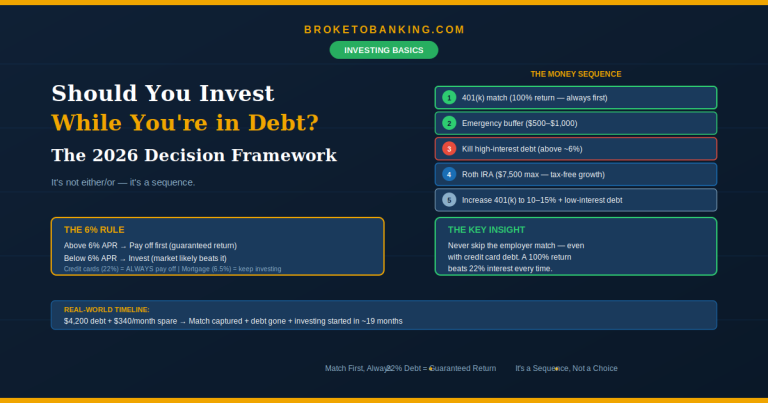
| Priority | Action | Why |
|---|---|---|
| 1st | 401(k) to the full match | 100% guaranteed return — nothing beats this |
| 2nd | Emergency fund | Build the Financial Armor buffer |
| 3rd | High-interest debt | Kill anything above 8% APR (credit cards first) |
| 4th | Roth IRA ($7,500 max) | Tax-free growth with better investment options |
| 5th | Back to the 401(k) | Increase toward 10–15% of income |
The 401(k) match comes first — even before paying extra on debt. A 100% match return beats the 22% you’re paying on credit cards. Get the free money, then attack the debt.
Pro tip: Set your contributions to auto-escalate — most plans let you automatically increase your contribution by 1% each year. You’ll never feel the increase, but over a decade it transforms your retirement savings.
FAQ
What if my employer doesn’t offer a 401(k)?
Open a Roth IRA on your own — up to $7,500 in 2026 at brokerages like Fidelity or Schwab with $0 minimums. See our Roth IRA guide.
What if there’s a 401(k) but no match and bad investment options?
Stack your Roth IRA first where you have total control over fees and funds. Only go back to the 401(k) if you’ve maxed the IRA and still want the tax advantage on additional savings.
What should I invest in inside my 401(k)?
For beginners, a target-date fund matched to your expected retirement year is the simplest choice. It diversifies automatically and adjusts risk as you age. If available, a low-cost total stock market index fund is another solid option — the One-Fund Start approach.
Can I withdraw money early?
Technically yes, but you’ll owe income taxes plus a 10% penalty if you’re under 59½. There are some hardship exceptions, but in general, treat 401(k) money as locked. If you can’t survive without it, you aren’t ready to max it out yet — capture the match and build your emergency fund first.
What happens to my 401(k) when I change jobs?
Three options: leave it with the old employer’s plan, roll it into your new employer’s 401(k), or roll it into an IRA. Rolling into an IRA at a low-cost brokerage usually gives you the most options and lowest fees. Whatever you do, don’t cash it out — taxes, penalties, and lost compound growth make that one of the most expensive financial mistakes you can make.
This article is for educational and informational purposes only. BrokeToBanking.com does not provide financial advice. Please consult a qualified financial professional for guidance specific to your situation.
BrokeToBanking is an independent personal finance blog. We may earn commissions from products we recommend. Our editorial opinions are never influenced by affiliate relationships.
Related Articles: