How to Negotiate a Higher Salary in 2026 (Exact Scripts That Work)
Quick Verdict: A 15-Minute Conversation Can Be Worth $634,000
Everything we’ve written on this site — budgeting, debt payoff, investing, automation — is about optimizing the money you already have. But there’s a faster lever most people never pull: earning more.
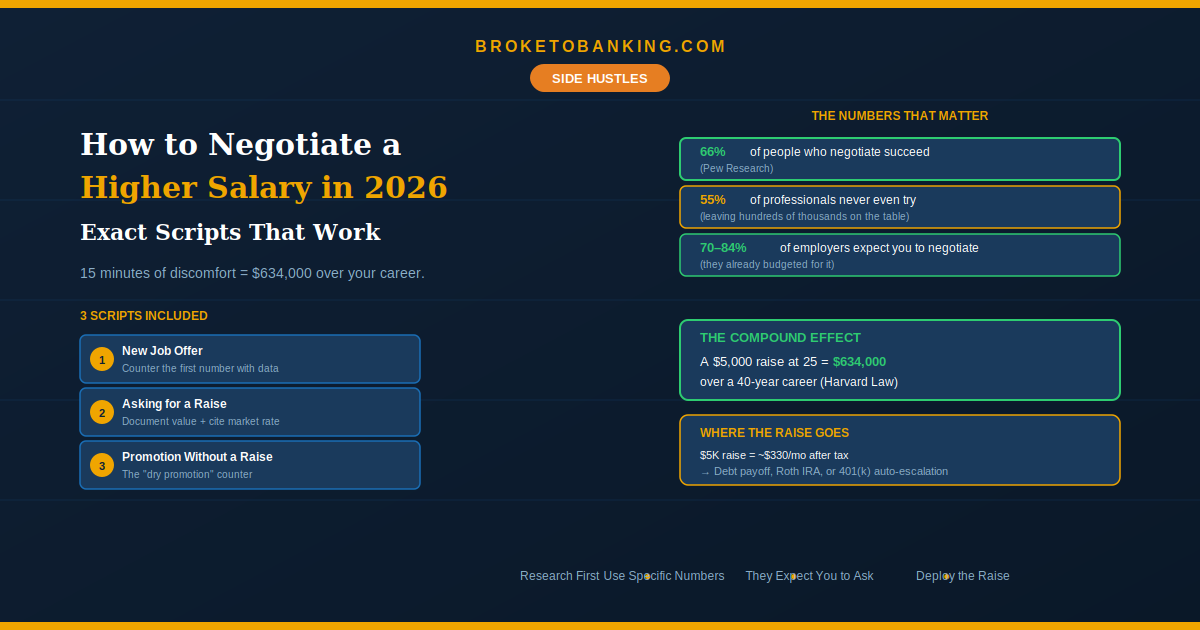
According to Harvard Law School research, a 25-year-old who negotiates their starting salary up by just $5,000 will earn approximately $634,000 more over a 40-year career, thanks to raises, bonuses, and promotions compounding on that higher base. Yet Pew Research shows 55% of professionals never even try. Not because they got turned down — because they never asked. That’s the Silence Tax: the career-long penalty for staying quiet.
Here’s the stat that should light a fire: about 66% of people who negotiate succeed, with average increases around 18%. And 70–84% of hiring managers expect you to negotiate — the money is already budgeted. You’re the only one losing by not asking.
In 2026’s “Disciplined Market” — where the Great Resignation is a memory and employers are making targeted investments in high-impact talent rather than across-the-board raises — negotiation isn’t optional. It’s how you capture the gap between what they offer and what they’ve budgeted.
The Quick Verdict:
- STACK: Negotiate every job offer — the first number is almost never their best ✅ — With 8+ states now requiring salary transparency in postings, you have more data than ever.
- STACK: Research your market rate before the conversation ✅ — Specific numbers backed by data get results. Vague asks get vague answers.
- RUNNER UP: If base is locked, pivot to total compensation — Signing bonus, remote flexibility, PTO, upskilling stipend, accelerated review.
- SKIP: Accepting the first offer out of gratitude ❌ — Gratitude is a polite emotion. It’s not a compensation strategy.
Before You Say a Word: The Research Phase
You can’t negotiate what you don’t know. Spend 30 minutes on these tools:
The classics: Glassdoor (company-specific pay), Levels.fyi (tech total comp: base + equity + bonus), Bureau of Labor Statistics / bls.gov (official government data by occupation and metro area).
The 2026 additions: If you’re in a salary transparency state (CA, NY, WA, CO, and others), check the job posting itself — the company was legally required to post the range. That’s your anchor. Tools like Comprehensive.io and Pave aggregate real payroll data that’s more accurate than self-reported numbers.
Find three numbers:
- Your target: 75th percentile. This is what you ask for.
- Your minimum: 50th percentile. The lowest you’d accept.
- Your walk-away: Below this, you decline or stay put.
Write them down. Negotiating on feelings instead of data almost always ends with you folding at the first pushback.
Script 1: Negotiating a New Job Offer
When you get an offer, don’t respond immediately. Express enthusiasm and buy 24–48 hours.
“Thank you so much — I’m genuinely excited about this opportunity and the team. I’d love to take 24 hours to review everything so I can come back with a thoughtful response. Does that work?”
Then call back with your counter:
“I’m really excited about this role and want to make it work. Based on my research — including data from Glassdoor and the BLS for this role in [city] — the market range is $X to $Y. Given my experience with [specific accomplishment], I was hoping we could get closer to $Z. Is there flexibility there?”
The 2026 transparency move: If you’re in a state with posted salary ranges: “I noticed the posted range for this role was $90K–$115K. Given my track record with [specific metric], I was targeting a base closer to the top of that band, at $112K. Is there room to move closer to that number?” You’re not guessing — you’re holding them to their own published range.
If they say salary is firm:
“I completely understand. Would it be possible to discuss the rest of the package? Things like a signing bonus, extra PTO, remote flexibility, or an accelerated review at six months with a salary adjustment tied to clear goals?”
Total comp often has more wiggle room because it comes from different budgets. Remote work alone is worth roughly 8% of salary in real value according to Stanford research.
Script 2: Asking for a Raise at Your Current Job
Prep work (2–4 weeks before):
- Document your top accomplishments from the past 12 months with real numbers
- Research the current market rate for your role
- Time the conversation well (after a big win, during budget season) — not during layoffs
The script:
“I’d like to talk about my compensation. Over the past year, I’ve [accomplishment 1] and [accomplishment 2], which contributed [quantifiable result] to the team. Market data for this role in our area shows $X to $Y, and I’m currently below the midpoint. I’d like to discuss adjusting to $Z to better reflect my contributions.”
The 2026 angle: If you’ve used AI tools to increase your output, lead with it: “I’ve increased my output by [X]% by integrating [workflow/tool], saving the team [Y] hours per week.” In 2026, managers are obsessed with efficiency — showing you do the work of 1.5 people is the ultimate leverage.
If they say “not in the budget”:
“I understand budgets can be tight. Could we set a timeline — say six months — with clear milestones? If I hit those goals, we revisit compensation then. I want to make sure we’re aligned on what success looks like.”
Get any agreement in writing — even a follow-up email. A verbal promise that doesn’t appear in writing doesn’t exist.
Script 3: Promotion Without a Raise (The “Dry Promotion”)
This is the #1 trend of 2026 — about 13% of promotions come with zero pay increase. More responsibility, same paycheck, “until next budget cycle.”
“I’m excited to step into [new role]. Since this comes with significantly expanded scope — specifically [responsibility A] and [responsibility B] — the current compensation doesn’t align with the market rate for this level. If the base is fixed for this quarter, can we agree in writing to an accelerated review in 90 days with a pre-set adjustment of [X%] once I hit [specific goal]?”
This is collaborative, not confrontational. It lets the manager defer slightly while giving you a written commitment to a future raise. The worst outcome is they say no — and even then, you’ve signaled that you know your market value.
The Negotiation Mistakes That Cost You Money
Naming your number first (when possible, let them go first). If forced, give a range with your target at the bottom.
Negotiating against yourself. State your ask, then stop talking. Silence is uncomfortable — the next person to speak usually concedes.
Making it personal. “I need more because my rent went up” doesn’t work. “My contributions and market data support a higher number” does.
Skipping the follow-up. If they agree to anything — raise, timeline, benefits — send a follow-up email summarizing the agreement. If it’s not in writing, it didn’t happen.
Where the Raise Goes (The BrokeToBanking Way)
A $5,000 raise on $50,000 is roughly $330/month after taxes. Deploy it the day it hits — don’t let Lifestyle Inflation eat it. A 10% raise doesn’t mean a 10% more expensive car. That’s how you stay Broke to Banking forever.
- Still in debt? Throw it at the highest-interest card — saves months and hundreds in interest
- Debt-free? Automate it into your Roth IRA — $330/month is $3,960/year toward the $7,500 max
- Already investing? Increase your 401(k) by the raise amount. You’ll never feel the difference, but your retirement will.
The raise only counts if it goes somewhere. Don’t let it vanish into Checking Account Gravity.
Negotiation is a skill, not a personality trait. Spend 15 minutes being uncomfortable today to buy yourself an extra decade of retirement later.
FAQ
When’s the worst time to ask?
During layoffs, right after a bad quarter, or when your boss is under visible stress. Best: after a big win, during annual reviews, or when you’ve taken on major new responsibilities.
What if I have no leverage?
You always have some. Document wins, bring data, and ask. Even a “not now” plants the seed and gets you a timeline.
Should I mention another offer?
Only if it’s real and you’re willing to leave. Bluffing with a fake offer is career-ending if discovered.
How much should I ask for?
New job counter: 10–20% above the initial offer. Internal raise: 5–15% based on accomplishments and market data. Dry promotion: research the market rate for the new title and aim for the midpoint.
This article is for educational and informational purposes only. BrokeToBanking.com does not provide financial advice. Please consult a qualified financial professional for guidance specific to your situation.
BrokeToBanking is an independent personal finance blog. We may earn commissions from products we recommend. Our editorial opinions are never influenced by affiliate relationships.
Related Articles: