How to Automate Your Finances in 2026 (Set It Up Once, Never Think About It Again)
Quick Verdict: Willpower Fails on Wednesday Afternoon — Systems Don’t
If you’ve read more than a couple of articles on this site, you’ve noticed one thing we say over and over: automate everything. The Ghost Paycheck. The Squeeze. DRIP. Auto-escalation. Automatic bill pay. It’s not random advice — it’s the core philosophy.
Here’s why: willpower is a finite resource. One stressful week at work, one sick kid, one “I’ll do it tomorrow” — and that extra credit card payment just doesn’t happen. Over 60% of Americans struggle to stick to a budget, not because they’re irresponsible but because they’re human. Automation isn’t about being efficient. It’s about being kind to your future self — building a system that protects you from your own Wednesday afternoon brain.
You spend one afternoon setting things up. Then your money flows to the right places on the right days without you touching it. You stop being the engine and start being the pilot.
The Quick Verdict:
- STACK: Ghost Paycheck transfer on payday — before you see the money ✅
- STACK: Autopay every recurring bill ✅ — Late fees and penalty APRs are a Loyalty Tax you never need to pay.
- STACK: Automate investments (monthly buy + DRIP) ✅ — Investing should be a background process, not a hobby.
- SKIP: Manually budgeting and moving money around every month ❌ — You will fall off. The system won’t.
The Automated Money Flow (The Reverse Budget)
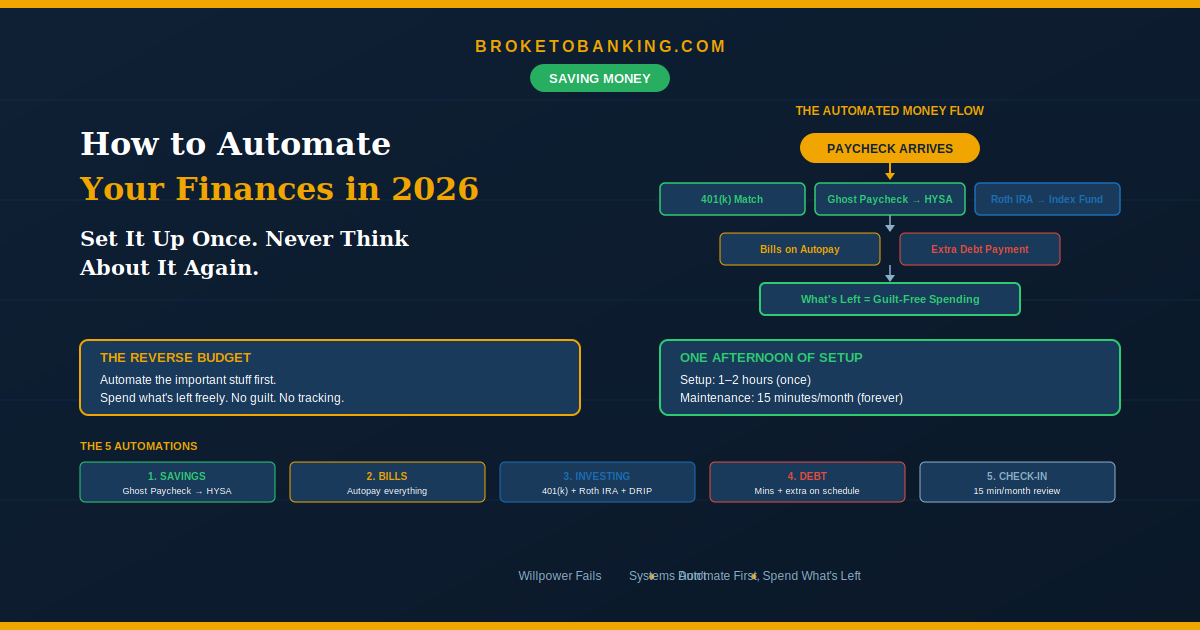
Most people fail at budgeting because they try to track every latte. The Reverse Budget flips that: automate the important stuff first, and whatever’s left in checking is yours to spend — guilt-free. No spreadsheets. No stress.
Paycheck hits →
- 401(k) contribution deducted pre-tax (automatic through employer)
- Ghost Paycheck transfers to HYSA (emergency fund / savings)
- Roth IRA contribution pulls from checking on a set date
- Bills autopay from checking (rent, utilities, insurance, phone, debt minimums)
- Whatever’s left = guilt-free spending money
Retirement funded. Emergency fund growing. Bills paid on time. And the money in checking is actually yours to spend. No guilt, no math.
Step 1: Automate Your Savings (The Ghost Paycheck)
Set up a recurring transfer from checking to your high-yield savings account for the day after payday.
Start with whatever you can — $50, $100, $200. The exact amount matters less than the automation. If you never see the money, you don’t miss it. By the time you check your balance, it’s already vanished into your Financial Armor.
Use a separate HYSA, not your checking account. Money in checking gets spent — that’s Checking Account Gravity. Separation creates clarity.
Even better: if your employer allows split direct deposit, send a portion straight to savings before it ever touches checking.
Step 2: Automate Your Bills (Kill the Loyalty Tax)
Late fees and penalty APRs are a Loyalty Tax you’re paying to corporations for the privilege of forgetting. A single missed payment can trigger a Credit Nuke that tanks your score — payment history is 35% of your FICO. Autopay makes this risk disappear.
Set every recurring bill to autopay: rent/mortgage, utilities, phone, internet, car payments, insurance, student loans, and credit card minimums.
Credit card tip: Set autopay to the full statement balance to avoid carrying a balance and paying interest. If you can’t pay in full yet, autopay the minimum to protect your score and manually pay extra when you can.
The Cash Cushion: Keep about one month’s worth of bills as a buffer in your checking account. This acts as a shock absorber — timing mismatches between deposits and autopay will never overdraft you.
Step 3: Automate Your Investments (The Background Process)
401(k): Already automatic through payroll. Contribute at least enough for the full employer match. Set a calendar reminder on your birthday to increase by 1% — the auto-escalation strategy. You won’t notice it in your paycheck, but your 65-year-old self will want to buy you a drink.
Roth IRA — The Roth Squeeze: Set up a recurring monthly transfer from checking to your Roth IRA at Fidelity, Schwab, or Robinhood. Then set up automatic purchases of your index fund — VTI, VOO, or FZROX. $625/month maxes out the $7,500 annual limit. Even $50/month starts the compounding chain.
DRIP: Make sure dividend reinvestment is toggled ON. Every penny your money earns goes right back to work. Pulling dividends out is cutting your own compounding legs off.
Automation enforces dollar-cost averaging — same amount, same day, regardless of what the market is doing. This removes the temptation to time the market, which almost always backfires.
Step 4: Automate Your Debt Kill
If you’re still in the debt payoff phase of the Money Sequence, weaponize your automation:
Minimums on autopay: Every card, every loan. Non-negotiable — this protects your credit score.
The extra payment as a “subscription”: Set up a recurring extra payment to your target card — even $25/week. Treat your debt payoff like a subscription service you’re paying for. This is the fastest way to escape Interest Gravity without relying on motivation.
When one debt is paid off, redirect that automated payment to the next target. Same amount, new destination. The momentum keeps going.
Step 5: The 15-Minute Pilot’s Check (Monthly)
Automation doesn’t mean you check out completely. You stop being the engine and start being the pilot. Once a month — maybe while drinking your coffee — do a 15-minute audit:
- Check the Cushion: Is your checking account buffer healthy?
- Scan for surprises: Any rate increases, billing errors, or weird charges?
- Kill the Zombies: Did any subscriptions creep back in?
- Confirm transfers: Did savings, Roth IRA, and debt payments go through?
- High-five yourself: Look at your HYSA balance and Roth IRA. The system is working.
That’s all. 15 minutes. The system handles the other 99%.
The One-Afternoon Automation Checklist
- [ ] Ghost Paycheck transfer (or split direct deposit) to HYSA
- [ ] 401(k) contribution at least to the employer match
- [ ] Roth IRA recurring transfer + automatic index fund purchase
- [ ] DRIP turned ON in brokerage settings
- [ ] All bills on autopay (rent, utilities, phone, insurance, loans)
- [ ] Credit cards set to autopay full statement balance (or minimum)
- [ ] Extra debt payment on recurring schedule
- [ ] Cash Cushion maintained in checking (~1 month of bills)
- [ ] Birthday reminder for 401(k) auto-escalation (1% increase)
- [ ] Monthly 15-minute check-in on your calendar
FAQ
What if I overdraft?
Keep the one-month Cash Cushion and set low-balance alerts from your bank. Most send a notification when you drop below a threshold you choose.
Should I automate credit card payments?
Yes — at minimum, autopay the minimum payment. Ideally the full statement balance so you never pay interest.
What if my income is irregular?
Automate based on your lowest reliable month using the Baseline Budget System. In good months, manually move the surplus to savings or debt. The floor is automated; the upside is manual.
How much time does this save?
After the initial 1–2 hour setup, you’ll spend 15 minutes a month instead of hours worrying about money. Financial freedom isn’t about how much you make — it’s about how little you have to worry about it. Set the system up today and let it work while you sleep.
This article is for educational and informational purposes only. BrokeToBanking.com does not provide financial advice. Please consult a qualified financial professional for guidance specific to your situation.
BrokeToBanking is an independent personal finance blog. We may earn commissions from products we recommend. Our editorial opinions are never influenced by affiliate relationships.
Related Articles: