YNAB vs EveryDollar 2026: Which Zero-Based Budgeting App Actually Wins?
Quick Verdict: The Cult of Methodology vs. The Ramsey Machine
If you’re still mourning the death of Mint, let’s be clear: neither of these apps is a replacement. Mint was a passive observer that watched you go broke in high definition. YNAB and EveryDollar are active participants — Zero-Based Budgeting tools that demand you give every single dollar a job before you spend it.
But while the math is the same, the worldviews are warring.
YNAB is a flexible toolkit. It teaches you a powerful way to think about money without prescribing exactly what to do with it. It doesn’t care if you use the debt snowball, avalanche, or your own system. It’s for people who want control, data, and long-term clarity.
EveryDollar is a guided program. It lives inside Dave Ramsey’s world — Baby Steps, debt snowball, “credit cards are evil” built right in. If you’re already following Ramsey, it feels like the app was made specifically for you. If you’re not, it quietly steers you toward a path you didn’t necessarily choose.
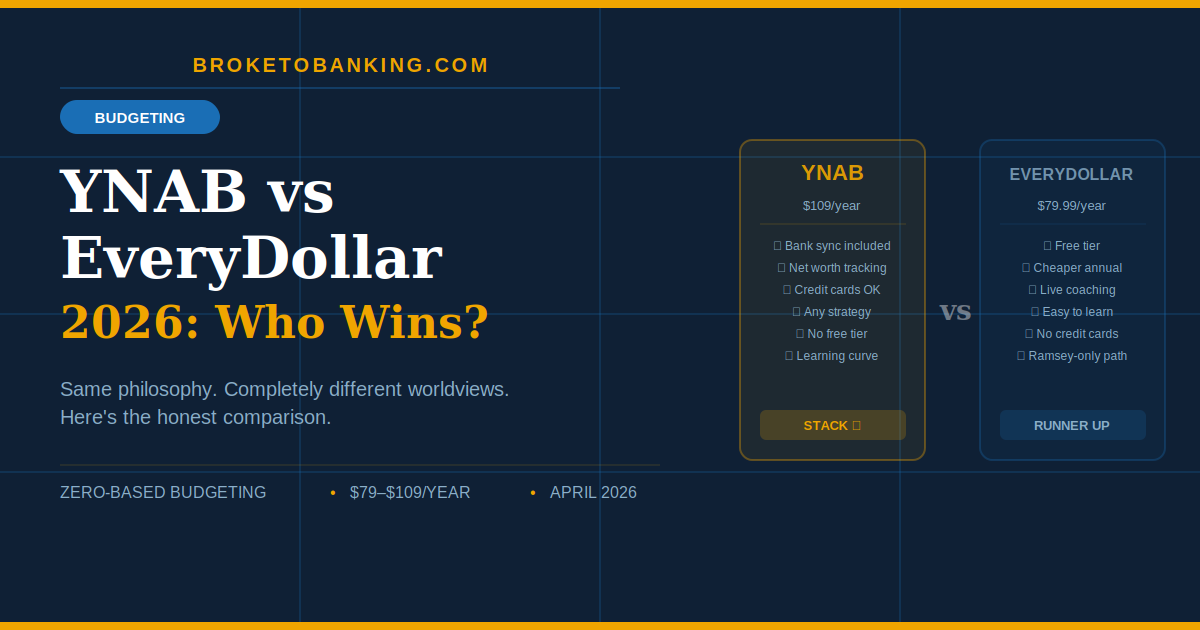
The Stack (Best for most people): YNAB — more flexible, better reporting, bank sync included from day one, and a methodology that works regardless of your financial situation. The $109/year is a Success Tax that actually pays for itself. The Runner Up: EveryDollar Annual — $29 cheaper than YNAB, genuinely usable free tier, and the clear winner if you’re all-in on Ramsey’s Baby Steps. The Skip: EveryDollar Monthly at $17.99/month ($216/year). This is one of the most overpriced utility app tiers on the market. It costs more than YNAB’s annual plan for fewer features. Never pay monthly for EveryDollar.
The Post-Mint Reality
Quick context that matters: Mint shut down in early 2024, leaving millions of users without a home. A lot of people landing on these two apps are either Mint refugees or people specifically looking for zero-based budgeting instead of a passive tracker.
If you mainly want automatic categorization and a spending overview — neither of these is the right replacement. That’s Monarch Money or Quicken Simplifi territory.
YNAB and EveryDollar are for people ready to stop just tracking spending and start planning it in advance. If that’s you, read on.
Pricing — The Number That Actually Matters
| YNAB | EveryDollar | |
|---|---|---|
| Free tier | ❌ (34-day trial only) | ✅ Manual entry, actually usable |
| Annual price | $109/year | $79.99/year (Premium) |
| Monthly price | $14.99/month | $17.99/month |
| Bank sync included | ✅ All plans | ❌ Premium only |
| Annual savings vs monthly | $71/year | ~$136/year |
| College students | Free for 1 year | N/A |
The pricing verdict: EveryDollar wins on annual cost — $29 cheaper. YNAB wins on monthly pricing. If bank sync matters, YNAB includes it in the base price while EveryDollar charges extra.
The Monthly Billing Trap: EveryDollar at $17.99/month is $215.88/year — more expensive than YNAB’s annual plan. If you choose EveryDollar, pay annually or don’t pay at all.
The “Projected Income” Trap — The Fundamental Difference
Verdict: CRITICAL SKEPTICISM ⚠️ (for EveryDollar users with irregular income)
This is the real difference between these two apps — and most comparisons gloss over it.
EveryDollar’s approach: You start by entering your expected monthly income, then allocate that total across categories until you hit zero. You’re budgeting projected income — money you haven’t received yet. It’s like drawing a map of a city you haven’t visited. If your paycheck is smaller than expected, your whole budget collapses like a house of cards.
YNAB’s approach: You can only budget money you actually have in your bank account right now. If your account shows $2,400, you assign that $2,400 to categories. When your next paycheck lands, you budget the new money. The goal over time is to be spending money you earned last month, not this month (“Age Your Money”).
The Skeptic’s Take: For freelancers, gig workers, or anyone with variable income, EveryDollar’s projected income approach is genuinely risky. YNAB’s cash-on-hand logic is the only way to survive irregular income without accidentally overspending a paycheck that hasn’t fully arrived yet.
For salaried employees with predictable paychecks, either approach works fine. The difference only bites you when reality diverges from your projections.
The Credit Card War
YNAB: STACK ✅ | EveryDollar: SKIP ❌ (if you use cards)
Dave Ramsey’s philosophy is essentially “plastic surgery” — cut up the cards. EveryDollar reflects this. It doesn’t facilitate tracking credit card transactions because in Ramsey’s world, you shouldn’t have them.
YNAB’s credit card logic is genuinely clever. When you buy $50 of gas on a credit card, YNAB automatically moves $50 from your “Gas” category into a “Credit Card Payment” category. It ensures you always have the cash set aside to pay the bill in full when it arrives. It treats credit cards as a cash flow tool, not a debt trap.
The bottom line: If you use credit cards for rewards, cash back, or building credit, EveryDollar will fight you every single day. YNAB will help you use them intelligently. This alone disqualifies EveryDollar for a significant portion of people — decide where you stand before downloading anything.
The Philosophy Difference — Financial Parent vs. Flexible Toolkit
EveryDollar is built around Dave Ramsey’s Baby Steps. The app gently steers you toward the debt snowball (smallest balance first). The January 2026 relaunch added a Margin Finder (identifies breathing room in your budget), personalized plans, daily financial lessons, and live group coaching on Premium.
If you need a “financial parent” to provide structure, accountability, and a clear roadmap, EveryDollar’s $79.99/year is a bargain compared to any private coaching. The Ramsey framework has helped millions of people get out of debt — if that framework resonates with you, the app amplifies it.
YNAB is methodology-agnostic. Its four rules (Give Every Dollar a Job, Embrace Your True Expenses, Roll With the Punches, Age Your Money) are about how to think about money in general — not which debt to pay first or how much to invest. If you already know how to manage money and want a high-powered tool that syncs with your bank and gets out of your way, YNAB delivers. If you want someone to tell you exactly what to do, it won’t fill that role.
Full Feature Comparison
| Feature | YNAB | EveryDollar |
|---|---|---|
| Zero-based budgeting | ✅ | ✅ |
| Bank sync | ✅ All plans | ✅ Premium only |
| Auto-categorization | ✅ | ❌ Manual drag-and-drop even on Premium |
| Net worth tracking | ✅ | ❌ |
| Loan payoff simulator | ✅ | ✅ |
| Debt snowball support | ✅ Flexible | ✅ Ramsey method built-in |
| Credit card tracking | ✅ | ❌ |
| Live group coaching | ❌ | ✅ Premium |
| Daily financial lessons | ❌ | ✅ Premium |
| Shared budgets | Up to 5 users | ✅ Partner sharing |
| Apple Watch app | ✅ | ❌ |
| Reports and analytics | ✅ Detailed | Limited |
| Learning curve | Higher (2–4 weeks) | Lower (15 minutes) |
| Free tier | ❌ | ✅ |
The feature verdict: YNAB wins on features and flexibility. EveryDollar wins on simplicity and guided experience.
Why People Quit Each App — The Honest Friction Report
Why people quit YNAB: The “First Month Fog” Because you can’t budget future money, the first 30 days feel broken. You’ll feel like you don’t have enough money because the app is forcing you to face your True Expenses — that $600 car insurance bill due in 6 months, the annual subscription you forgot about. This isn’t a bug. It’s the most important thing YNAB does. But it feels terrible at first, and most quitters leave during this window.
Why people quit EveryDollar: The “Manual Fatigue” On the free plan, you log every coffee and every taco by hand. For some people this is the feature — the friction forces intentionality. For others, it breaks down by week two. On the Premium plan at $17.99/month, the math eventually becomes obvious and people delete it out of what can only be described as spite. This is the monthly pricing trap in action.
The Steelman Case for Each
Why YNAB wins for most people:
- Bank sync included at the base price — no upgrade required
- Works with any financial philosophy, any debt strategy
- Better reporting and net worth tracking
- Handles credit cards intelligently
- “Age Your Money” framework is genuinely transformative for irregular income earners
- Once the method clicks, it changes how you think about money permanently
Why EveryDollar wins for its target user:
- Free tier is genuinely functional — the only zero-based app that offers this
- Cheaper on the annual plan
- New users can start budgeting in 15 minutes
- Live coaching and daily lessons add real value for people who need accountability
- Built-in Ramsey Baby Steps integration is seamless if you follow that program
- Manual drag-and-drop on Premium keeps you engaged with every transaction
Who Should Use What
Choose YNAB if:
- You use credit cards (even just for rewards or cash flow management)
- Your income is irregular or variable
- You want detailed reporting and net worth tracking
- You’re willing to invest 2–4 weeks learning a more powerful system
- You don’t follow Dave Ramsey specifically
Choose EveryDollar if:
- You follow (or want to follow) Dave Ramsey’s Baby Steps
- You want a free starting point with no credit card required
- You want coaching, accountability, and daily guidance built in
- You mostly use cash or debit
- You want the simplest possible entry into zero-based budgeting
Choose neither if:
- You want automatic categorization and easy spending reports — try Monarch Money or Quicken Simplifi
- You want subscription tracking and bill negotiation — try Rocket Money
The Bottom Line
Budgeting is about friction. The right app gives you just enough friction to stop spending mindlessly — but not so much that you stop tracking entirely.
Don’t pay $17.99/month for EveryDollar. It’s a bad trade and the math is embarrassing. Either commit to the YNAB methodology and pay the $109 annual Success Tax, or use EveryDollar’s free manual version until you’ve proven you’ll actually stick with the habit — then upgrade to the $79.99 annual plan.
If you’re a data-oriented person who uses credit cards, wants irregular income support, and is willing to invest two weeks learning a new way to think about money — YNAB will change your financial life. If you need a guided path with a coach and a clear roadmap, and you’re ready to follow Ramsey’s framework — EveryDollar at $79.99/year is a steal.
FAQ
Which is better for absolute beginners? EveryDollar — lower learning curve and a genuinely usable free tier. YNAB if you’re willing to invest a couple of weeks upfront for a more powerful long-term system.
Does EveryDollar work if I don’t follow Dave Ramsey? The budgeting mechanics still work. But the app is built around Ramsey’s framework and you’ll encounter that framing everywhere. If it feels like noise rather than guidance, YNAB will feel cleaner.
Is YNAB worth $109 a year? For people who fully engage with the zero-based methodology, yes. Once it clicks, most users report saving significantly more than the subscription cost. For passive trackers who just want a spending report, it’s overpriced.
Can I use both apps simultaneously? There’s no reason to. Pick one philosophy and commit. Splitting attention between two budgeting systems undermines both.
Can these apps replace Mint? Not directly. Neither is a true Mint replacement — they require more active planning and have steeper learning curves. For a Mint-style experience, Monarch Money is the most commonly recommended alternative.
BrokeToBanking is an independent personal finance blog. We may earn commissions from products we recommend. Our editorial opinions are never influenced by affiliate relationships. Pricing is accurate as of April 2026 — verify current plans at each app’s website before subscribing.
Related Articles: