Do You Need Renters Insurance? (Yes, and Here’s Why It’s Cheaper Than You Think)
Quick Verdict: It Costs Less Than Netflix and Protects Everything You Own
If you’re renting an apartment in 2026, there’s one financial product most people skip despite it costing less than a single night of takeout: renters insurance.
The average policy costs roughly $15–$23/month — $180 to $276/year. For the price of a couple of coffees a week, you get protection for everything you own (clothes, laptop, phone, furniture), liability coverage if someone gets hurt in your place, and temporary housing if your apartment becomes unlivable.
Your landlord’s insurance covers the building — the bricks, the walls, the floors. It does not cover the life inside them. If your apartment floods, catches fire, or gets broken into, their policy replaces the structure. You replace your own belongings — out of pocket. Without renters insurance, one bad event can cost $5,000–$20,000, wiping out your emergency fund or sending you right back into credit card debt. A single burst pipe could set your Net Worth Scoreboard back five years.
The Quick Verdict:
- STACK: Get renters insurance — the cheapest Financial Armor available ✅ — $15–$23/month for $20K–$40K in protection.
- STACK: Choose replacement cost, not actual cash value ✅ — ACV pays what your 3-year-old laptop is “worth” ($200). Replacement cost pays what a new one costs ($800). Skipping this is penny wise, pound foolish.
- RUNNER UP: Bundle with auto insurance — Most insurers offer 10–15% off, effectively making the renters portion cost pennies.
- SKIP: Assuming your landlord covers you ❌ — They insure the bricks. You insure the life inside them.
The 2026 Cost Comparison
| Expense | Monthly Cost | What You Get |
|---|---|---|
| Netflix Premium | $26.99 | 4K streaming |
| 6 coffees | ~$22 | Caffeine for a week |
| Renters Insurance | ~$23 | $30K in property protection + $100K liability |
Your landlord gets a check if the building burns down. You get $0 unless you have a policy.
What Renters Insurance Actually Covers
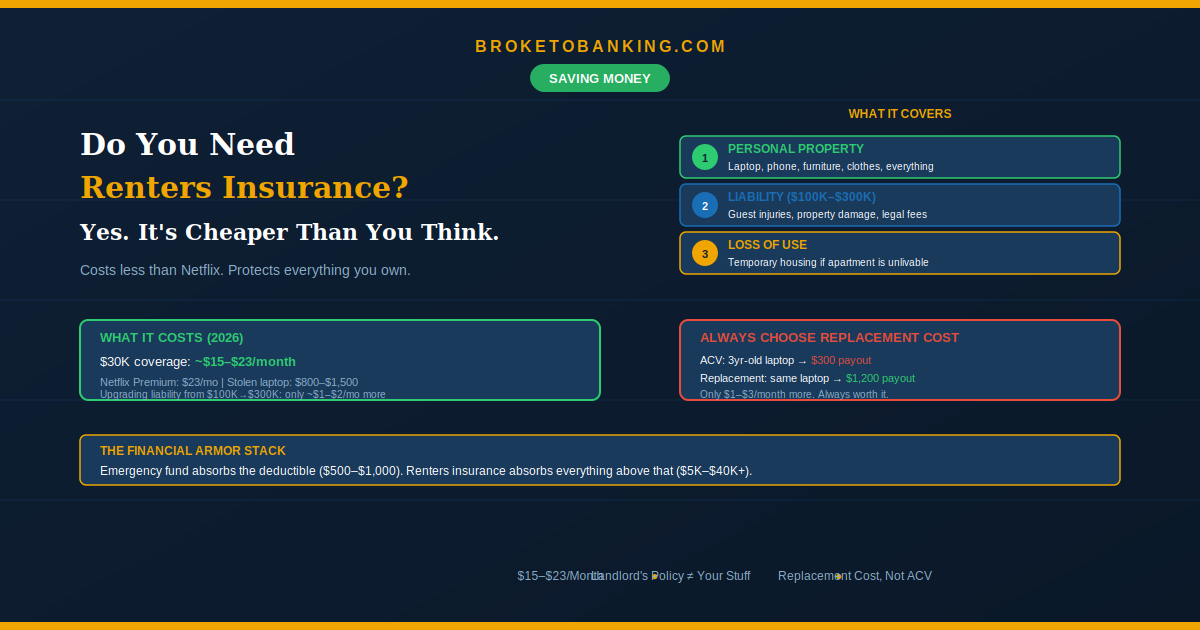
1. Personal Property — Covers your belongings if stolen, damaged, or destroyed by fire, theft, vandalism, burst pipes, smoke, or windstorms. This includes electronics, furniture, clothing, kitchen items — everything. Most renters need $20,000–$40,000 in coverage. You probably own more than you think: smartphone ($900+), laptop ($1,200+), TV ($500+), wardrobe ($2,000+), furniture ($2,500+). That’s $7,000+ before anything sentimental.
2. Liability ($100K–$300K) — Protects you if a guest gets injured in your apartment or if you accidentally damage someone else’s property. Covers legal fees, medical bills, settlements. Upgrading from $100K to $300K costs only $1–$2/month more.
3. Loss of Use — If your apartment becomes unlivable (fire, major water damage), your policy pays for temporary housing and related costs while repairs happen.
Replacement Cost vs. Actual Cash Value (Read This)
This is the #1 mistake renters make — and the most important choice in the policy.
Actual Cash Value (ACV): Pays the depreciated value. Your $1,200 laptop from 3 years ago is “worth” $300 today. That’s what you get. You’re still out $900 for a replacement.
Replacement Cost: Pays what it actually costs to buy a comparable new item. Laptop destroyed → insurer pays $1,200.
The difference in premium: $1–$3/month. Always choose replacement cost. There’s no clearer value proposition in personal finance.
How to Get a Policy (10 Minutes)
1. Get quotes from 3–4 providers online. Lemonade, State Farm, GEICO, Progressive, Allstate. Start with your auto insurer — bundling saves 5–15%.
2. Choose coverage: $30,000 personal property + $100,000 liability is a solid starting point.
3. Pick replacement cost (not ACV).
4. Choose your deductible. $500 is standard. $1,000 saves 10–20% on the premium — but only if you have the Financial Armor to cover it.
5. Set to autopay and add to your automation checklist.
Where It Fits in the Financial Plan
Renters insurance belongs right after your $1,000 Financial Armor starter fund. Once you have that buffer, you need to protect it from catastrophic external events — and at $23/month, this is the cheapest protection available.
The Financial Armor Stack: Your emergency fund absorbs the deductible ($500–$1,000). Your renters policy absorbs everything above that ($5,000–$40,000+). Without the policy, your emergency fund has to cover everything — and a $15,000 apartment fire will destroy most people’s savings.
Insurance isn’t for the “usually.” It’s for the “once.” Don’t let a faulty wire in your neighbor’s unit destroy your path to wealth.
The Skeptic’s Friction Report
“I don’t own $30,000 worth of stuff.” You’d be surprised. Smartphone ($900), laptop ($1,200), TV ($500), wardrobe ($2,000+), furniture ($2,500+), kitchen gear ($500+) — that’s over $7,000 before you count a bike, instruments, or camera equipment. Most renters hit $15K–$20K easily.
“My state is too expensive.” Even Louisiana (the most expensive state at ~$36/month) costs less than a week of convenience spending. In most states, it’s $15–$25.
“I’ve never had a claim.” That’s the point. Insurance protects your emergency fund so a $10,000 theft doesn’t wipe out your entire Financial Armor in one afternoon.
FAQ
Is renters insurance required?
Not by law. But many landlords now require it as a lease condition. Even if optional, it’s worth getting.
Does it cover my roommate?
No — each person needs their own policy.
Does it cover floods or earthquakes?
Standard policies don’t cover external flooding or earthquakes. Burst pipes and internal water damage are typically covered. If you’re in a high-risk area, you’ll need separate flood insurance.
What about my stuff outside the apartment?
Most policies cover belongings anywhere — laptop stolen from your car, luggage lost while traveling. Check your policy for specific off-premises limits.
How do I file a claim?
Document everything. Photos of damaged items, police report for theft, and contact your insurer within 24–48 hours. Having a home inventory (even photos on your phone) makes it dramatically faster.
This article is for educational and informational purposes only. BrokeToBanking.com does not provide financial advice. Please consult a qualified financial professional for guidance specific to your situation.
BrokeToBanking is an independent personal finance blog. We may earn commissions from products we recommend. Our editorial opinions are never influenced by affiliate relationships.
Related Articles: