How Much Should You Have Saved by 30? (The Real Numbers, Not the Fantasy)
Quick Verdict: The Benchmark Is 1x Your Salary — But Most People Aren’t Even Close
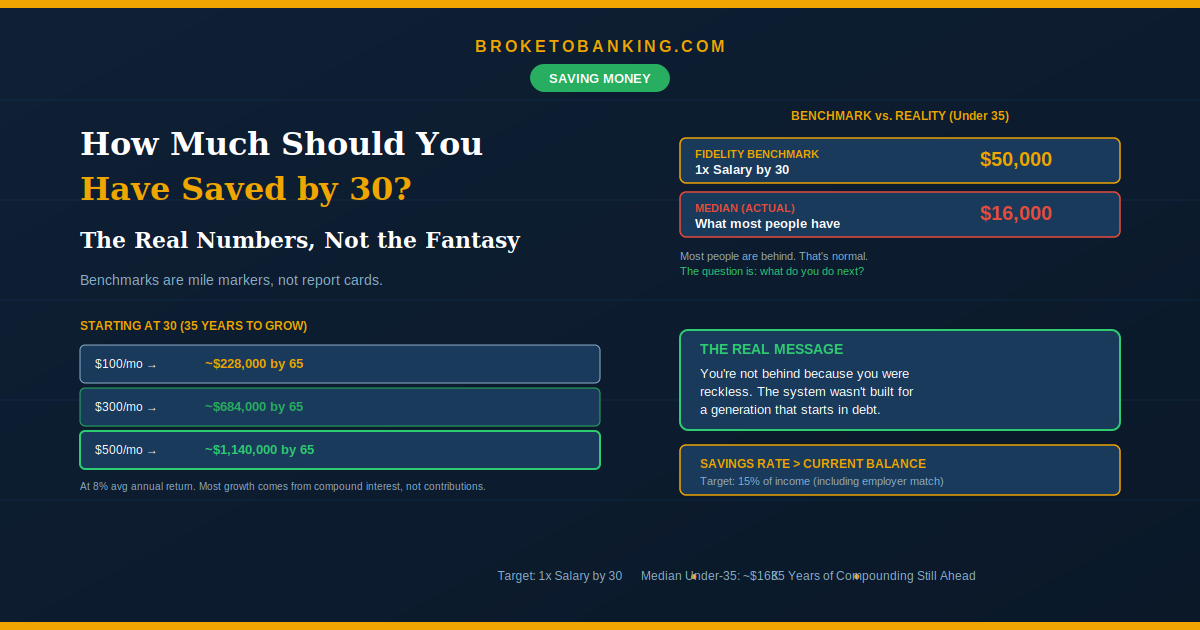
The most common guideline comes from Fidelity: aim to have 1x your annual salary saved for retirement by age 30. If you make $50,000, that means $50,000 in retirement accounts. By 40, the target jumps to 3x. By 50, 6x. By 67, 10x.
Those numbers are clean and simple. They’re also completely disconnected from what most people actually have.
According to Vanguard’s data, the median retirement savings for Americans under 35 is roughly $16,000. The average is higher (~$42,000), but that’s pulled up by trust funds and high-earning anomalies — skip the average, the median is the only number that matters for a reality check. If you have $50,000 saved by 30, you’re ahead of about 60% of your peers.
Here’s what actually matters: these benchmarks are mile markers, not report cards. Think of the 1x target as a North Star, not a pass/fail grade. Missing it doesn’t mean you’ve failed — it means you know how much ground to make up. And at 27 or 30, you still have the most powerful asset in finance: time. That’s the Compound Interest Cheat Code from our compound interest guide.
The Quick Verdict:
- STACK: Direction over destination ✅ — If you’re contributing 15% of income (including employer match), you’ve already won. Your balance is a snapshot; your savings rate is your trajectory.
- STACK: Start now, even if you’re “behind” ✅ — $500/month (~$16/day) from age 30 at 8% returns becomes roughly $1.14 million by 65.
- RUNNER UP: Follow the Money Sequence — Match → buffer → debt → Roth IRA → increase. See our framework.
- SKIP: Beating yourself up for not saving at 22 ❌ — You can’t change the past. You can change the next 35 years.
The Benchmarks vs. The Reality (The 2026 Audit)
| Metric | The “Fantasy” (Fidelity) | The “Reality” (Vanguard Median) |
|---|---|---|
| Balance at 30 | 1x Annual Salary | ~$16,000 |
| Recommended Savings Rate | 15% | ~6.8% actual |
| Common Barrier | “Overspending” | Student loans + rent (the Survival Tax) |
The experts’ benchmarks assume you’ll need to replace 70–80% of pre-retirement income, Social Security covers about 40%, and investments handle the rest. Someone with a paid-off home might need less; someone supporting dependents might need more.
| Age | Fidelity Target | T. Rowe Price Target | At $50K Salary |
|---|---|---|---|
| 30 | 1x salary | 0.5–1x | $25,000–$50,000 |
| 35 | 2x salary | 1–1.5x | $50,000–$100,000 |
| 40 | 3x salary | 2–3x | $100,000–$150,000 |
| 50 | 6x salary | 5–6x | $250,000–$300,000 |
| 67 | 10x salary | 7–13.5x | $500,000+ |
Why the Gap Exists (Skip the Guilt Trip)
The “save 1x by 30” rule was written for a world where people started careers at 22 with no debt, got immediate 401(k) access, and saved 15% from day one. That’s not 2026.
The reality: graduated with student loans, spent years in jobs without a 401(k), dealt with credit card debt from the gap between entry-level pay and actual living costs. The Survival Tax — rent, loans, and the basic cost of existing — doesn’t leave room for a 15% savings rate at 24.
Here’s the reframe: if you spent your 20s getting a degree, building skills, or starting a career, you were investing in Human Capital. That investment has a high ROI — it just doesn’t show up in a 401(k) balance yet. You’re not behind because you were reckless. You’re behind because the system wasn’t designed for a generation that starts adulthood in debt.
The Math That Should Make You Feel Better
Even starting from $0 at 30, the numbers work. Consistent investing over 35 years at 8% average annual return:
| Monthly Investment | Total Contributed | Value at 65 |
|---|---|---|
| $100/month | $42,000 | ~$228,000 |
| $200/month | $84,000 | ~$456,000 |
| $300/month (~$10/day) | $126,000 | ~$684,000 |
| $500/month (~$16/day) | $210,000 | ~$1,140,000 |
At $300/month you’re on track for nearly $700,000 by 65. Most of that growth is compound interest, not contributions. And $50,000 invested at 30 with zero additional contributions grows to ~$737,000 by 65. Time is a more powerful lever than your starting balance.
The Action Plan (The Money Sequence for Your 30s)
Don’t throw money blindly at the market — that’s a Risk Tax you can’t afford. Follow the sequence:
1. Capture your 401(k) match. Guaranteed 50–100% return. See our 401(k) guide.
2. Build $1,000 in Financial Armor. Keep the next emergency off your credit card. See our emergency fund guide.
3. Kill high-interest debt. Credit card debt at 22% = Interest Gravity pulling you backward. See our debt payoff plan.
4. Fund a Roth IRA. $7,500 limit in 2026. Tax-free compounding for 35+ years. See our Roth IRA guide.
5. Auto-escalate your 401(k). Increase by 1% every year — do it on your birthday so you never forget. You won’t feel it, but over a decade it transforms your retirement. Target 15% total including the match.
Match → buffer → debt → Roth → increase. One step at a time.
The Savings Rate Matters More Than the Balance
Your savings rate is a better predictor of retirement readiness than your current balance. A 28-year-old saving 15% with $5,000 in the bank is stronger than a 28-year-old with $40,000 from a gift who saves 0%. The balance is a snapshot. The rate is a trajectory.
Fidelity recommends 15% total (your contributions + employer match). If 15% feels impossible, start with what you can and increase 1% per year. At $50,000, going from 5% to 6% is an extra $42/month. Over 30 years, each 1% adds tens of thousands.
FAQ
I’m 30 with almost nothing saved. Is it too late?
Not even close. $200/month from 30 becomes ~$456,000 by 65. The gap between starting at 25 and 30 matters — but the gap between 30 and never is infinity.
Does the 1x benchmark include my 401(k)?
Yes — all retirement savings. 401(k), Roth IRA, traditional IRA. Not your emergency fund or taxable brokerage.
What if I don’t have a 401(k)?
Open a Roth IRA at Fidelity, Schwab, or Robinhood — $0 minimum, $7,500 limit. See our investing apps guide.
Retirement or student loans first?
Capture the match (always). Pay debt above ~6% before investing beyond the match. Federal loans below 6% are fine to carry while funding a Roth IRA. See our full framework.
The bottom line: You can’t change what you saved at 24. You can only control what you deploy at 30. Stop looking in the rearview mirror — the Interest Gravity of regret is the only thing that will actually keep you from hitting 3x by 40.
This article is for educational and informational purposes only. BrokeToBanking.com does not provide financial advice. Please consult a qualified financial professional for guidance specific to your situation.
BrokeToBanking is an independent personal finance blog. We may earn commissions from products we recommend. Our editorial opinions are never influenced by affiliate relationships.
Related Articles: