How to Save Money on Groceries in 2026 (Without Couponing Your Life Away)
Quick Verdict: The Biggest Savings Come From Systems, Not Coupons
Groceries are the largest controllable expense in most people’s budgets. We used $350/month in our budget example, but for many households the real number is higher. Food prices are roughly 20% higher than four years ago, and the average American household spends about $500/month. For a single person, the USDA moderate plan runs $328–$388/month.
You don’t need extreme couponing or a diet of plain rice to cut this number. The strategies that actually move the needle are boring systems: planning meals, shopping with a list, choosing store brands, and not throwing away food you already paid for. Most people can cut 15–25% — $75–$125/month — by changing habits, not their menu.
Deploy that $100/month into the Money Sequence, and it becomes $1,200/year toward your emergency fund, debt payoff, or Roth IRA.
The Quick Verdict:
- STACK: Meal plan + grocery list before every trip ✅ — The single most impactful change. Kills impulse buys and food waste in one move.
- STACK: Switch 10 staples to store brand ✅ — Saves $75–$100/month with zero sacrifice in quality.
- RUNNER UP: Shop once per week — Fewer trips = fewer impulse buys. 10–15% savings from consolidation alone.
- SKIP: Extreme couponing as a lifestyle ❌ — The ROI on hours clipping paper coupons is below minimum wage. Use digital store apps instead.
The $1,500 You’re Throwing Away
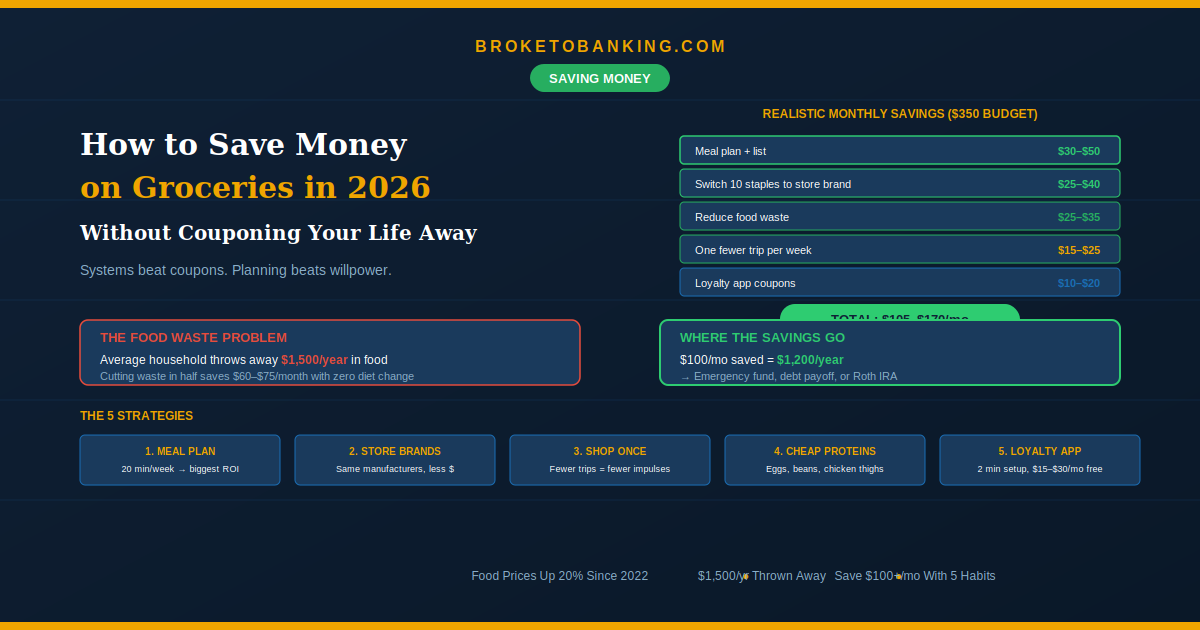
The average American household throws out roughly $1,500 worth of food per year — $125/month. Before you change what you buy, fix the waste:
Shop your kitchen first. Before making your list, check fridge, freezer, pantry. This is the grocery version of Pantry Week. Build at least one meal around what’s about to expire.
Use your freezer aggressively. Bread, meat, cooked leftovers, and most vegetables freeze well. If you won’t eat it by Tuesday, freeze it on Monday.
Store produce correctly. Berries in the fridge, bananas on the counter, leafy greens in a damp paper towel. Adds days to freshness.
Cutting food waste in half saves the average household $60–$75/month — without changing a single thing about what you eat.
The 5 Strategies That Actually Save the Most
1. Meal Plan Before You Shop (20 Minutes/Week)
Spend 15–20 minutes before your weekly trip deciding what you’ll eat. Write a list. Only buy what’s on it. This prevents impulse purchases, reduces waste, and stops the “nothing to eat, let’s order takeout” trap — which costs the average person $40+ per incident.
A note on your phone works fine. Plan 5 dinners (leftovers cover the rest), list breakfasts and lunches, and write down exactly what you need.
2. Switch to Store Brands on Staples
In 2026, store brands at Aldi, Trader Joe’s, Costco (Kirkland), and most chains are often made by the same manufacturers as name brands — different label, same product. Consumer Reports research confirms most shoppers now prefer store brands for pantry staples.
Switching 10 common items — pasta, rice, canned tomatoes, oats, peanut butter, oil, frozen vegetables, milk, bread, cereal — saves $75–$100/month. The easiest grocery savings available.
3. Shop Once Per Week
Every extra trip is an invitation for impulse buys. The “I just need milk” run consistently turns into $35–$50 of unplanned stuff. Consolidating to one weekly trip drops spending 10–15% from fewer impulse opportunities alone.
4. Buy Proteins Strategically
Meat is the most expensive cart category — beef prices up roughly 37% since 2019. You don’t need to go vegetarian, but treating meat as an ingredient rather than the centerpiece saves real money:
- Eggs, beans, lentils, tofu = cheapest high-quality proteins
- Chicken thighs cost roughly half what breasts do, taste better, and freeze better
- Buy in bulk on sale and freeze immediately
- One or two meatless dinners per week saves $30–$50/month on their own
5. Use Your Store’s Loyalty App
Download your store’s app (Kroger, Publix, Safeway, etc.). Tap the “Clip All” button on digital coupons before checkout. Takes 30 seconds and typically shaves $10–$20 off a $100 bill. If your store offers fuel points, the savings extend to the gas pump too.
This isn’t extreme couponing — it’s pressing a button on your phone.
Buy Frozen (The Underrated Move)
In 2026, flash-frozen vegetables are often more nutritious than “fresh” produce that sat on a truck for a week. They’re also 30–50% cheaper and never go bad before you use them. Frozen broccoli, spinach, mixed vegetables, and berries are some of the highest-value items in the store.
What About Costco?
Warehouse clubs make sense if you spend $250+/month on groceries and staples. The $65/year membership pays for itself if bulk buying saves $10/week on products you’d buy anyway.
The trap: A 5-pound bag of spinach is only a deal if you actually eat 5 pounds of spinach. If half goes in the trash, it’s a loss. Bulk is for shelf-stable items (rice, pasta, paper products) and proteins you freeze immediately — not perishables you can’t finish.
The Grocery Budget for Our Reader
For a single person spending $350/month:
| Strategy | Monthly Savings |
|---|---|
| Meal planning + list | $30–$50 |
| Switch 10 staples to store brand | $25–$40 |
| Reduce food waste | $25–$35 |
| One fewer trip per week | $15–$25 |
| Loyalty app digital coupons | $10–$20 |
| Total realistic savings | $105–$170 |
A $350 bill becomes $200–$250 with no change in what you eat. That $100+/month saved becomes $1,200/year that goes straight to your HYSA, debt payoff, or Roth IRA through the Ghost Paycheck.
Grocery savings aren’t about deprivation. You aren’t eating “cheap” food — you’re just being a more efficient manager of the food you already buy.
The Skeptic’s Friction Report
Meal planning takes time. About 20 minutes/week — and it saves $200+/month when you include fewer takeout orders. That’s a higher hourly rate than most side hustles.
“Eating cheap” doesn’t mean eating badly. Rice, beans, eggs, frozen vegetables, oats, and bananas are among the healthiest and cheapest foods available.
You’ll still eat out. That’s fine — budget for it in the “Wants” category of your 50/30/20 plan. The goal isn’t zero restaurants. It’s making sure your grocery budget isn’t secretly funding last-minute takeout because you failed to plan.
FAQ
What’s a realistic grocery budget for one person?
USDA moderate plan: $328–$388/month. With these strategies, $200–$250/month is very achievable while eating well.
Should I buy organic?
Only if it fits your budget. Conventional produce is nutritionally comparable for most items. If you want to prioritize, the “Dirty Dozen” list shows which produce has the most pesticide residue.
Grocery delivery — worth it?
It can help some people spend less — you see the running total, can remove items before checkout, and avoid in-store impulse buys. The $5–$10 fee may be worth it if it prevents $30+ in unplanned purchases. Test it.
This article is for educational and informational purposes only. BrokeToBanking.com does not provide financial advice. Please consult a qualified financial professional for guidance specific to your situation.
BrokeToBanking is an independent personal finance blog. We may earn commissions from products we recommend. Our editorial opinions are never influenced by affiliate relationships.
Related Articles: