Does Paying Minimum Payment Hurt Your Credit Score? (2026)
Quick Verdict: The Minimum Payment Paradox
If you’re making your minimum payments on time and wondering why your credit score is stuck in the mud, you’ve hit the Minimum Payment Paradox. In 2026, with the average credit card APR sitting at a brutal ~21–22%, the minimum payment is designed to do exactly one thing: keep you as a profitable customer for as long as possible. It’s the bare minimum required to prevent a Credit Nuke (a missed payment), but it’s also the primary reason your score won’t break into the 700s.
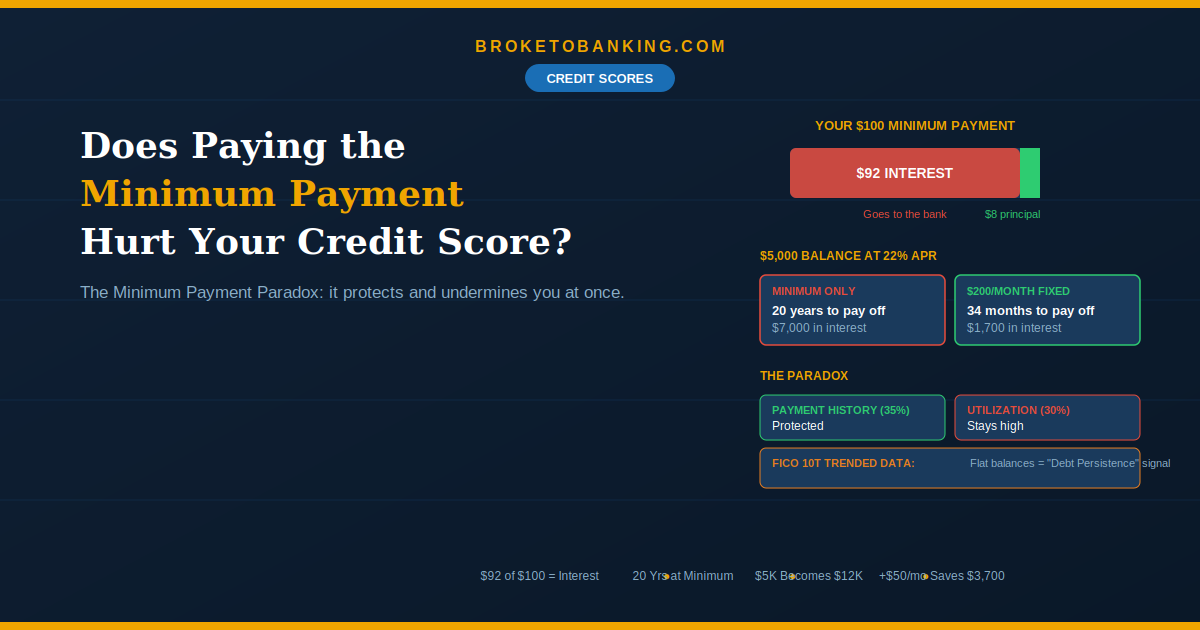
The minimum payment simultaneously protects your credit score and quietly undermines it. Paying on time builds positive payment history — 35% of your FICO score. But the payment barely touches your balance, which keeps your utilization high — and utilization is 30% of your score. It’s like walking on a treadmill: you’re moving, but you aren’t going anywhere.
The Quick Verdict:
- STACK: Pay even $20 above the minimum ✅ — In the era of trended data, showing a downward trajectory is the secret to unlocking the next 50 points on your score.
- STACK: The Statement Date Timing Play ✅ — Pay your bill 3 days before the statement closes. This forces the bank to report a lower balance to the bureaus, instantly dropping your utilization.
- SKIP: The “Auto-Minimum” Trap ❌ — Paying only the minimum and assuming you’re “building credit” is a delusion. You’re building interest for the bank while your score stays anchored by high utilization.
The Math: Why the Minimum Is a Success Tax
Most people don’t realize how little their minimum payment actually does. At ~22% interest, the bank takes their cut first.
On a $5,000 balance, your first $100 minimum payment only knocks about $8 off the actual debt. The other $92 is a gift to the bank. You aren’t paying off debt — you’re renting money at a luxury price. We call this the Minimum Payment Multiplier:
| Strategy | Monthly Payment | Payoff Time | Total Interest |
|---|---|---|---|
| Minimum only (2%) | ~$100, declining | ~20 years | ~$7,000 |
| Fixed $200/month | $200 | ~34 months | ~$1,700 |
| Fixed $300/month | $300 | ~20 months | ~$1,000 |
You borrow $5,000. With minimums, you pay back nearly $12,000. Adding just $50/month above the minimum saves approximately $3,700 in interest and cuts payoff time by over five years, according to credit card payoff calculator estimates.
How It Actually Affects Your Score
Your FICO score doesn’t distinguish between “paid minimum” and “paid in full.” It cares about two things: did you pay on time, and how much credit are you using?
Payment history (35%) — protected. As long as the minimum arrives by the due date, your account reports as “paid as agreed.” On this front, minimum payments do their job.
Utilization (30%) — anchored. Because minimums barely reduce your balance, your utilization stays high month after month. If you owe $5,000 on a $6,000 limit, your utilization is 83%. A $100 minimum payment drops that to roughly $4,992 after interest — barely a dent. This is the Utilization Anchor: it holds your score down regardless of how many on-time payments you make. To break the anchor, you have to get that balance below 30% — and ideally below 10%.
FICO 10T trended data — the ghost that’s quietly judging you. In 2026, most lenders have upgraded to FICO 10T. Unlike older models that only saw a snapshot of your debt today, this model looks at your trended data over the last 24 months. When it sees a balance that stays flat despite monthly payments, it reads Debt Persistence — you aren’t showing the ability or the will to actually kill the balance. Even paying $10 above the minimum creates a downward slope that FICO 10T reads as de-leveraging. If the graph of your debt is a flat line, your score will stay flat too.
The Skeptic’s Friction Report:
The Minimum Payment Paradox means your score can stagnate even while you’re making every payment on time. Under older scoring models, this was a slow drag. Under FICO 10T, your flat-balance pattern itself becomes a data point working against you.
When Is the Minimum the Correct Move?
There are three situations where paying the minimum is actually the smart play:
The Survival Window: If you have to choose between a minimum payment and a late payment, always pay the minimum. A Credit Nuke stays on your report for 7 years. The minimum is a band-aid that keeps you in the game.
The Avalanche Strategy: If you have three cards and you’re throwing every extra dollar at the one with 28% interest, then paying the minimum on the other two is mathematically correct. You’re putting out the house fire first. (We break down the full math in our Snowball vs. Avalanche comparison.)
The Hardship Call: If you genuinely can’t afford more, call the bank. In 2026, most major issuers have hardship programs that can temporarily drop your rate to 0–9% if you explain your situation. You’re more likely to get help while your account is still in good standing.
When to skip the auto-minimum mindset: If you have any extra cash sitting in a 4% savings account while you’re carrying 22% credit card debt, you’re losing roughly 18% on that money. That savings account feels safe, but the math says redirect it to the card first.
Getting Off the Treadmill
The Fixed Payment Lock: Pick a payment amount higher than your minimum — even $25 more — and pay that same amount every month. As the issuer reduces your minimum over time, your fixed payment stays the same, sending an increasingly larger share to principal.
The Statement Date Play: Pay as much as you can before your statement closing date — not just the due date. Your issuer reports the balance on the closing date. Pay 3 days before it closes and the bureaus see the lower number. This instantly improves your reported utilization.
The bottom line: Making the minimum payment is walking on a treadmill — you’re technically moving, but you’re not arriving anywhere. To actually reach the 700 club, increase the incline. Pay $20 extra, pay it 3 days early, and watch the algorithm start to favor you.
FAQ
Does paying the minimum on time count as a “good” payment?
Yes, for payment history purposes. Any payment at or above the minimum that arrives by the due date reports as “paid as agreed.” The bureaus don’t distinguish between minimum and full payment for this factor.
Will paying only the minimum lower my credit score?
Not directly — on-time minimums build positive payment history. But they keep your balance and utilization high, which suppresses your score through the amounts-owed factor. And under FICO 10T, the flat-balance pattern of Debt Persistence is an additional negative signal.
Is it better to pay the minimum or skip a month?
Always pay the minimum. Skipping results in a late fee, potential penalty APR, and — if you’re 30+ days late — a derogatory mark that stays for seven years. The minimum prevents all of that.
This article is for educational and informational purposes only. BrokeToBanking.com does not provide financial advice. Please consult a qualified financial professional for guidance specific to your situation.
BrokeToBanking is an independent personal finance blog. We may earn commissions from products we recommend. Our editorial opinions are never influenced by affiliate relationships.
Related Articles: